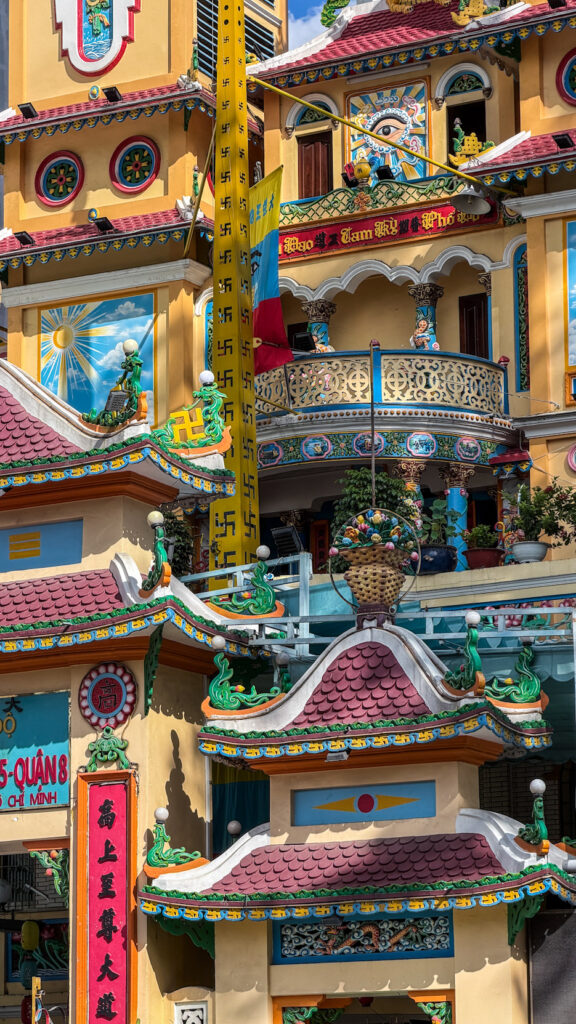
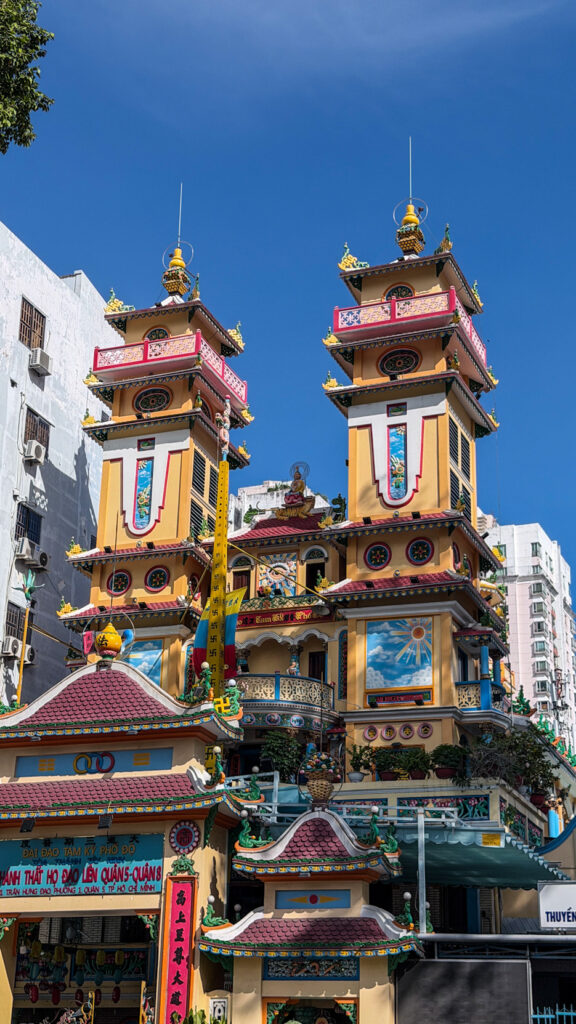
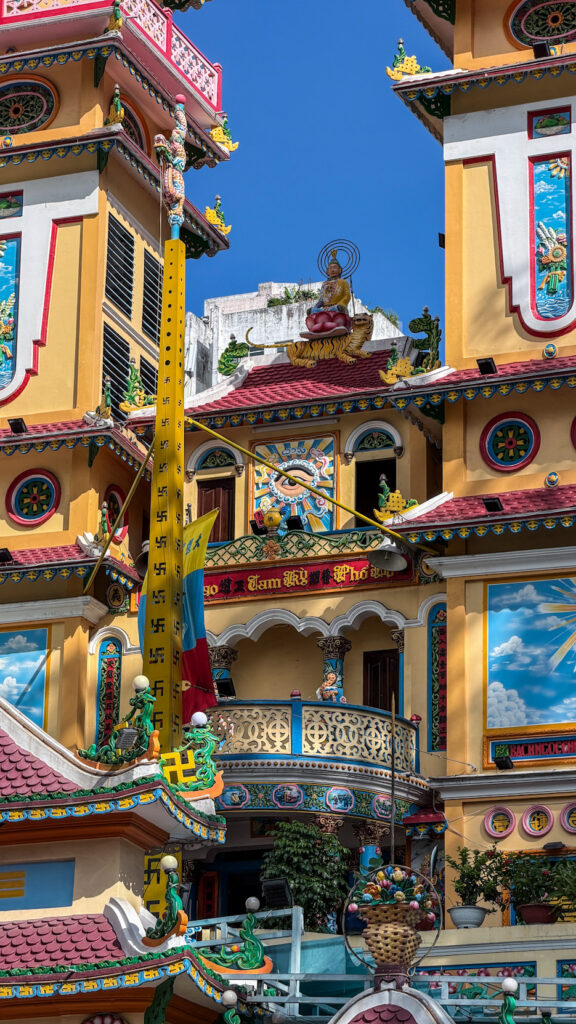
Most places of worship stick to one god. The Cao Dai Holy See in Tây Ninh is famous for it, but there’s a smaller, quieter temple right in Saigon that does something even more extraordinary — it fuses five different religions under a single, colourful roof. Cao Dai Temple Saigon — officially Thánh thất Sài Gòn — blends Buddhism, Taoism, Confucianism, Christianity, and Islam into one dazzling, kaleidoscopic faith. The result is a temple unlike anything else in Vietnam: pastel-coloured columns, a giant Divine Eye watching from above, and a serenity that feels worlds away from the motorbike chaos outside. If you’re already checking flights to Ho Chi Minh City and want a truly unique spiritual stop, this is it. 🎨
👁️ The Divine Eye That Sees Everything
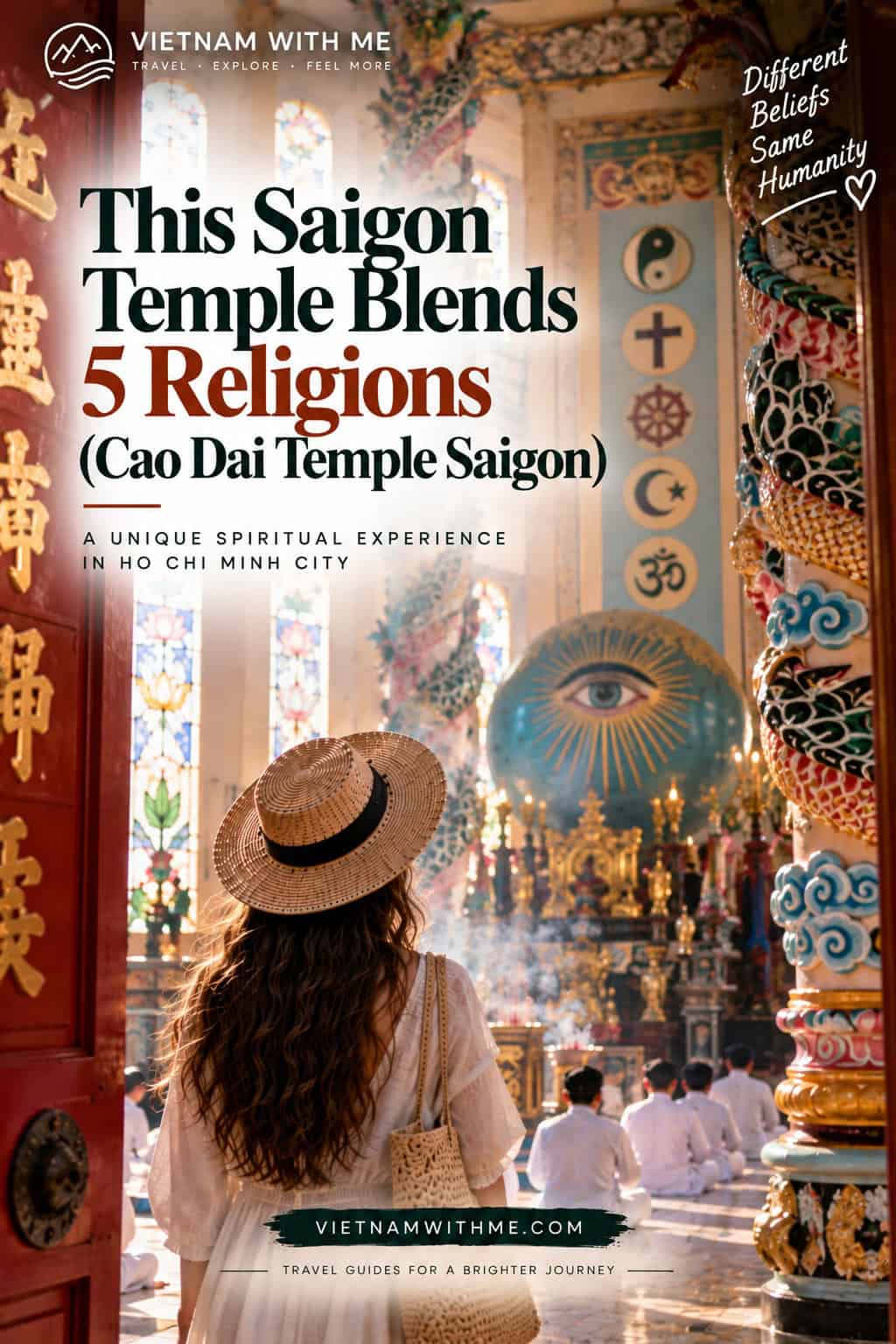
The moment you step inside, you’re greeted by the Divine Eye — a single, all-seeing eye painted on a globe, hovering at the centre of the main altar. It’s the most recognisable symbol of Caodaism, representing the supreme deity’s omnipresence. The altar itself is a multi-tiered masterpiece: saints, buddhas, and immortals are arranged in descending order, reflecting the religion’s hierarchy of spiritual figures. You’ll see Jesus Christ next to Confucius, Guan Yin next to a Taoist immortal. It sounds chaotic, but the symmetry and colour palette — soft yellows, sky blues, lotus pinks — make it feel harmonious rather than cluttered. The floor is cool marble, the air smells faintly of incense, and the silence is broken only by the occasional shuffle of a worshipper’s slippers. 🙏
⛪ A Sanctuary in the Heart of the City
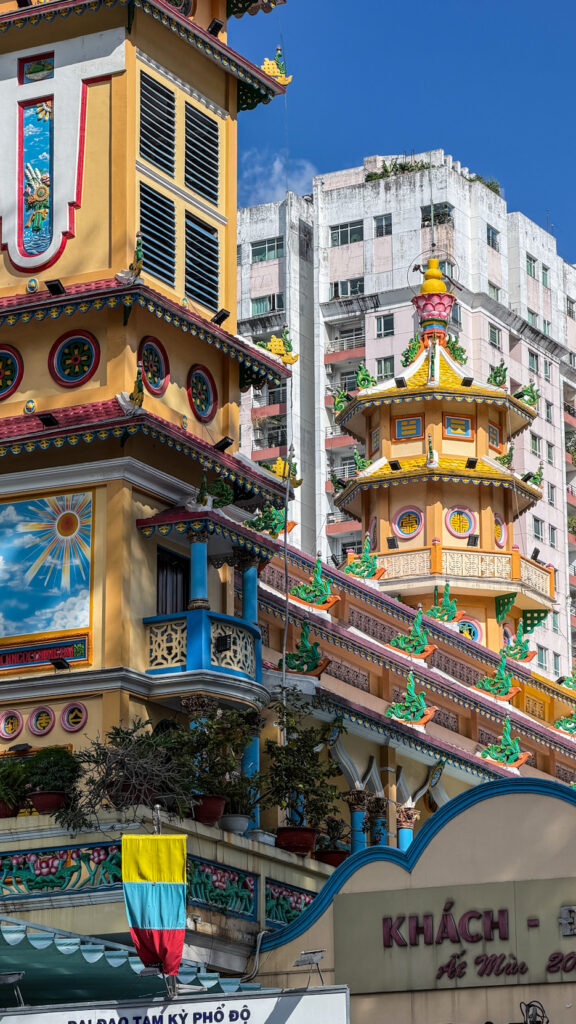
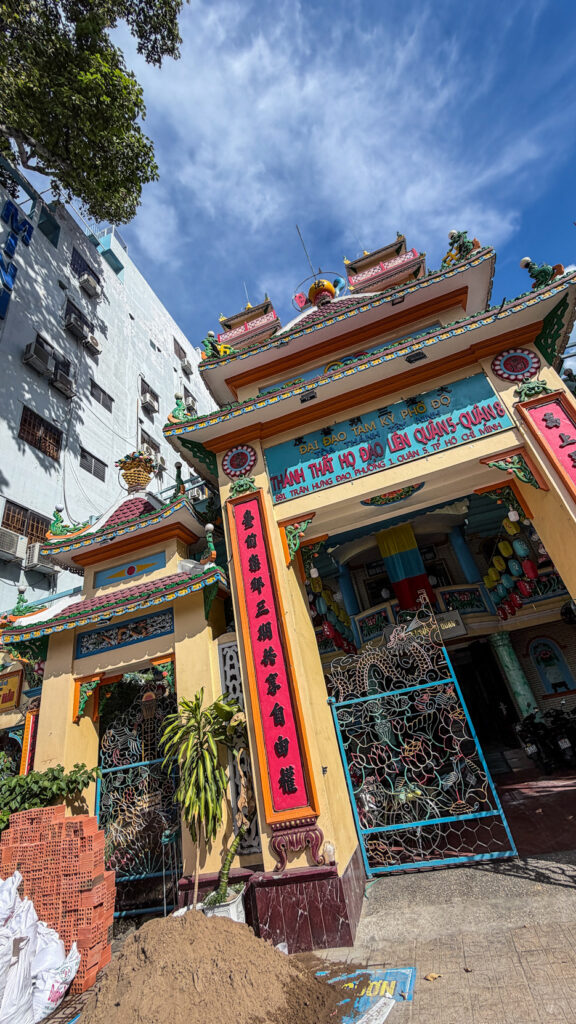
This temple belongs to the larger Cao Dai community of Saigon and serves as a central place of worship for followers in the city. Unlike the grand Holy See in Tây Ninh, which can feel like a tourist attraction during prayer sessions, this one remains genuinely local. You’re unlikely to see many other foreigners here. The temple compound includes a main sanctuary, smaller shrines, and a courtyard shaded by frangipani trees. The architecture borrows from French colonial churches — tall arched windows, ornate balustrades — but the dragons coiling up the pillars and the Chinese characters on the roof beams are unmistakably Eastern. It’s a building that refuses to choose a single identity, and that’s the entire point. 🌿
🕊️ Five Faiths, One Community
Caodaism was founded in 1926 in Tây Ninh province, and its core belief is that all major religions share the same divine origin. In practice, this means you’ll see elements of Buddhist karma, Taoist harmony, Confucian ethics, Christian charity, and Muslim prayer woven into a single doctrine. The temple hosts regular worship sessions where followers dress in flowing white robes — a striking sight against the colourful interior. If you’re lucky enough to witness a ceremony, you’ll hear chanting and see the congregation kneeling in perfect rows. Photography is usually permitted, but be discreet and avoid flash. The atmosphere during worship is deeply serene, and it’s worth timing your visit to coincide with a service if you can. 🕯️
📍 Practical Info
📍 Address: 116 Đường Số 9, Phường 15, Quận 11, Ho Chi Minh City (also known as Thánh thất Sài Gòn)
🕒 Open: Daily, from early morning until evening. Ceremonies typically take place at fixed times — ask locally or check online before you visit.
🎟️ Entrance: Free. A small donation box is available if you wish to contribute.
👗 Dress code: Shoulders and knees covered. Remove your shoes before entering the main sanctuary.
🚕 Getting there: About 15–20 minutes by Grab from District 1. Drivers will recognise “Thánh thất Sài Gòn” or the address on Đường Số 9.
The temple is located in District 11, not far from several other cultural landmarks. If you’re looking for a comfortable base nearby, you can find a hotel in Ho Chi Minh City — staying in the central districts puts you within easy Grab distance of this temple and many others. For the highest-rated stays across all budgets, my Top 10 Best Hotels in Ho Chi Minh City guide has the full lineup.
🔗 What to Pair It With
If you’re building a morning of temple‑hopping, Cao Dai Temple pairs beautifully with Giac Lam Pagoda, the oldest temple in Saigon, which is just a short Grab ride away. For a completely different kind of landmark, the Independence Palace tells the story of how the Vietnam War ended. And if you’re collecting spiritual corners, my upcoming Saigon pagodas guide will group several hidden temples into one essential list. 🌿
💎 Verdict: A Temple That Defies Labels
Cao Dai Temple Saigon doesn’t fit into a single box — and that’s exactly what makes it unforgettable. Come for the Divine Eye and the rainbow interior, stay for the silence, and leave with a deeper appreciation of a faith that sees no contradiction in unity. 🎨
Frequently Asked Questions
What religions does Cao Dai Temple Saigon blend?
Buddhism, Taoism, Confucianism, Christianity, and Islam.
What is the Divine Eye?
The temple’s central symbol — a single, all-seeing eye painted on a globe at the center of the main altar, representing the supreme deity’s omnipresence.
When was Caodaism founded?
In 1926, in Tây Ninh province.
Where is this temple located?
At 116 Đường Số 9, Phường 15, Quận 11, Ho Chi Minh City (also known as Thánh thất Sài Gòn).
Is this temple as touristy as the Cao Dai Holy See in Tây Ninh?
No, it remains genuinely local, and you’re unlikely to see many other foreigners here.
More from our travel guide network
Build your Vietnam route — free.