Honestly, I kept postponing my visit to this famous pagoda. Another temple, a tourist must‑see, crowds, souvenirs… I thought I had seen it all. But curiosity (and my friends’ photos) finally won. And you know what? This place surprised me. It turned out to be nothing like I had imagined. This is the home of the most impressive white Buddha Vietnam has to offer, and the climb to his feet is a rite of passage every visitor to Nha Trang should experience at least once.
If you’re still planning your arrival, the Cam Ranh airport is barely an hour’s drive from the temple. My Top 10 Best Hotels in Nha Trang guide can help you find something within walking distance, so the early‑morning climb becomes effortless.
🐉 How the Dragon Descended the Mountain: A Brief History
To understand this place, you need to know its story, and it is worthy of a mini‑series. Picture this: 1886. A monk named Thích Ngộ Trí builds a small wooden hut on top of Trại Thủy Mountain and calls it «Đàng Long Tự,» meaning «Temple of the Slowly Flying Dragon.»
Everything went well until 1900, when a powerful typhoon struck Nha Trang. The first sanctuary was completely destroyed. But the monks did not give up. Instead of rebuilding on the windswept peak, they moved the temple down to the foot of the mountain, where it stands today. Since then, the pagoda has changed its name, become the main Buddhist center of Khánh Hòa Province, and undergone several major renovations, transforming into the majestic site we know now. The dragon that once gave the temple its name may be mythical, but the resilience of the monks who rebuilt it is entirely real.
🏯 First Impressions: Mosaics and the Spirit of Asia
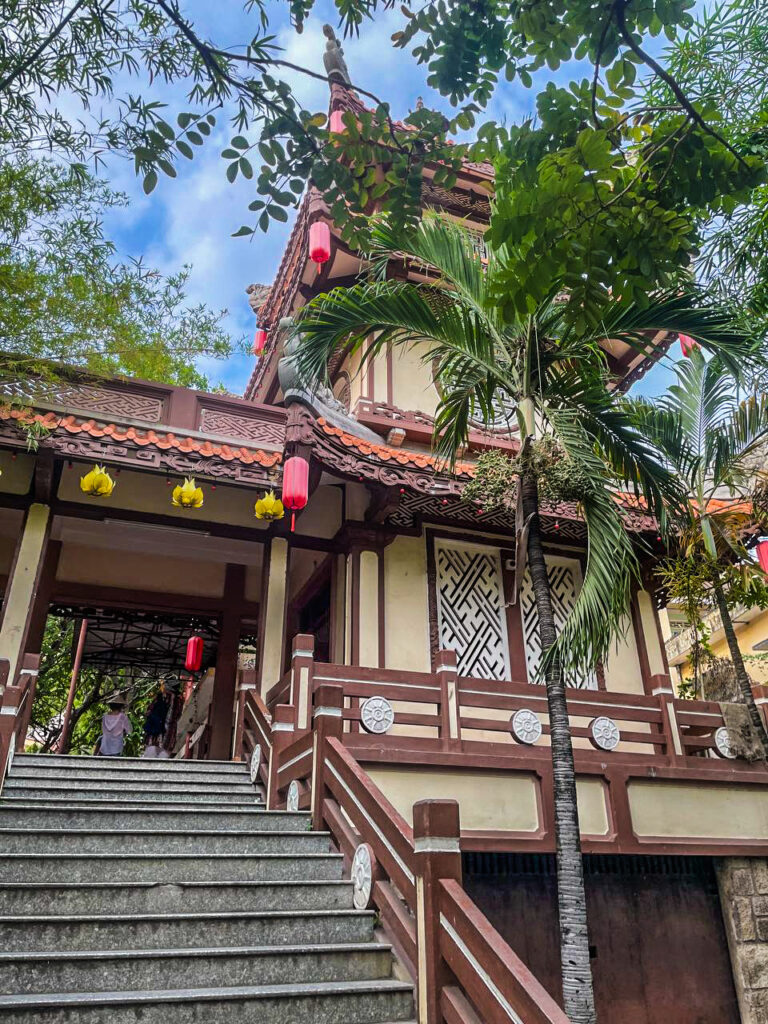
Entering the grounds is an event in itself. You pass through a three‑arched gate decorated with intricate glass and ceramic mosaics. You can immediately tell this is not just a tourist attraction but an active temple. To the left stands a monument to the monk Thích Quảng Đức, and to the right, a large brown stupa where incense smolders in memory of the departed.
The temple complex itself is a beautifully maintained garden filled with bonsai, potted chrysanthemums, and shaded benches. The air smells of incense, prayers hum softly, and somewhere in the background, leaves rustle quietly. Stone pillars with tiny shrines inside line the perimeter. The atmosphere is calming and sets the right mood — you might arrive stressed from the traffic, but five minutes in the garden and the tension starts to dissolve.
🦶 The Main Challenge: 152 (or 193?) Steps
After taking in all the ground‑level beauty, you finally face the main test. The staircase. Being the meticulous type, I counted: some sources say 150, others claim 193 — I counted 152 steps. The exact number does not matter; what matters is that the climb is real.
My advice: do not play the hero. If you arrive at noon, this is not just a staircase; it is a blazing hot frying pan. Bring water, wear comfortable shoes, and take your time. This is not a race; it is part of the spiritual journey (or at least a good cardio workout). The steps are uneven in places — worn smooth by decades of pilgrim feet — so watch your footing, especially on the way down.
🛌 A Secret Stop: The Reclining Buddha
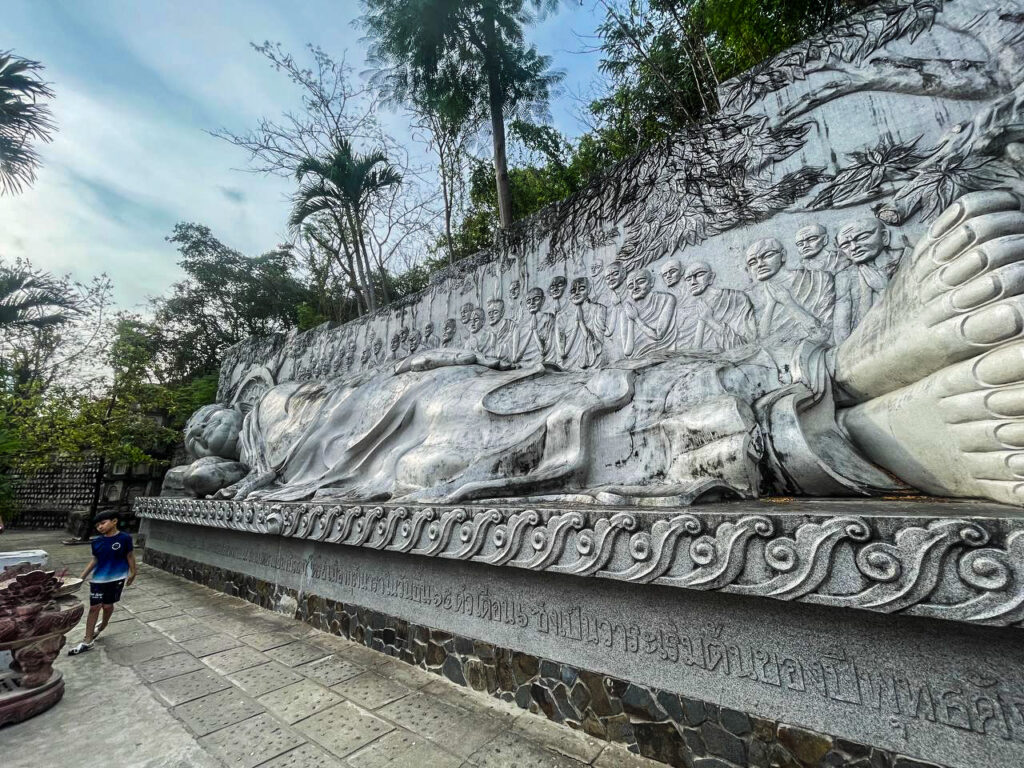
Around the 44th step, there is a turn to the left. Do not miss it! Hidden in the shade of the trees lies an enormous white statue of the Reclining Buddha entering nirvana. The statue measures 17 metres long and 5 metres high. He looks so peaceful that you almost want to lie down beside him and forget the hustle and bustle. This is a perfect «chill zone» before the final push. I’ve often found this spot nearly empty, even when the main staircase is busy — most people rush straight past it, too focused on the summit to notice the giant serene figure resting among the trees.
✨ He. The White Buddha.
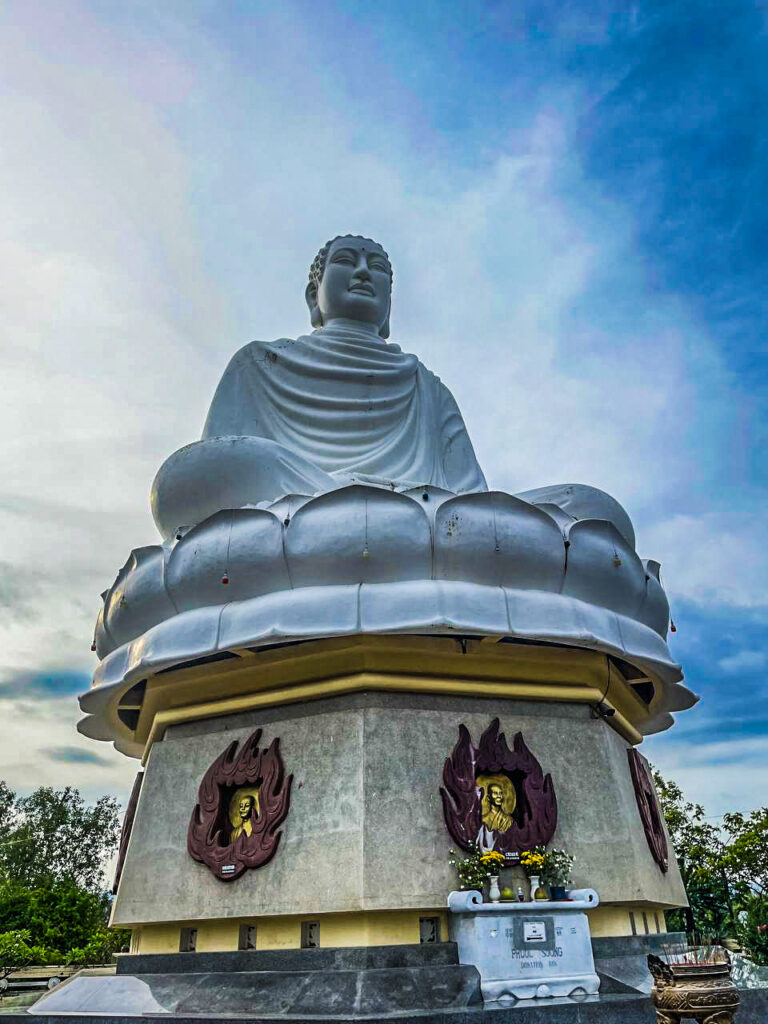
And so, after conquering the last steps, you see him. A 24‑metre statue of Shakyamuni Buddha (Kim Thân Phật Tổ) seated on a lotus flower. This white Buddha Vietnam landmark dominates the skyline. This is truly the largest Buddha statue in Vietnam. He is visible from almost any point in the city — you’ve probably already spotted him from your hotel window or the beach promenade.
And here is where things get interesting. Unlike many other statues, this Buddha does not smile. His face is stern, detached. He does not try to please you. Standing at his feet, you genuinely feel as though you are taking an important exam, and he is the chief examiner.
This feeling is not accidental. Inside the pedestal are bas‑reliefs depicting monks engulfed in flames — a reference to the tragic events of the Buddhist crisis of the 1960s, when monks self‑immolated in protest against persecution. This is not just decoration; it is a reminder of the price paid for faith. That is why he looks so serious. Take a moment to read the small plaques (some are translated into English) — they add a layer of historical weight that most visitors completely overlook.
🌆 The Reward: A Panorama of the City
But enough of the somber notes. Walk around the statue, and you will receive your well‑deserved reward. From this hilltop, you get perhaps the best panoramic view for miles around. The entire city spreads out before you: the curving coastline, the endless sea, misty mountains, and the rooftops below. This spot is especially beautiful as the city begins to glow with evening lights. I once timed my visit to coincide with sunset, and watching the sky turn orange behind the Buddha’s silhouette was genuinely unforgettable.
By the way, if you are still planning your trip and unsure how to best organize your time, I have a ready‑made route — a 9‑day itinerary that details exactly in what order to explore the city and its surroundings so you miss nothing.
🛡️ Practical Tips: How Not to Ruin Your Visit
To make your visit perfect, here are a few essential rules, tested from personal experience.
- ❌ DO NOT come at noon. You will melt under the sun, and the crowds will be unbearable.
- ✅ DO arrive early in the morning (around 7:00 AM) or after 4:30 PM. The light is softer, there are fewer people, and you can soak in the atmosphere in peace and quiet.
- ❌ DO NOT dress like you are going to the beach. Save the shorts and bare shoulders for the promenade. This is an active temple.
- ✅ DO dress modestly: cover your shoulders and knees. If you forget, you can borrow a robe at the entrance.
- ❌ DO NOT accept «free» incense. Vendors may offer it at the entrance and then demand payment.
- ✅ IGNORE pushy «guides» and beggars. Unfortunately, they can be found here. Go your own way and enjoy the visit.
- ❌ DO NOT rush. You came to a temple, not a race. Sit on a bench in the garden and listen to the silence.
- ✅ DO visit the Reclining Buddha. This small side adventure adds colour to your visit.
- ❌ DO NOT expect a restroom or café at the top. All facilities are at the bottom.
- ✅ DO bring water and wear comfortable shoes.
If you want the freedom to visit at dawn without waiting for a Grab, renting a car at Cam Ranh Airport lets you be at the temple gates in under an hour. For early‑morning visits, having your own wheels makes the whole experience far smoother. And while you’re exploring, staying online for maps is essential — I always activate a local SIM or eSIM before I leave home; it spares me the hunt for a SIM card and keeps the connection alive right from the temple courtyard.
💰 Cost and How to Get There
- Entrance: FREE. Any request for payment is a scam. If you wish to leave a donation, place money in the official boxes.
- Address: 22 Đường 23/10, Phường Phương Sơn, Nha Trang.
- Getting there: The easiest way is by taxi or Grab. A ride from the centre costs just pocket change. You can also walk if you are staying nearby and do not mind the heat. If you’re arriving from Cam Ranh Airport, pre‑booking a private transfer can help you avoid the taxi scrum outside the terminal.
🆚 Is It Worth It? Long Son vs. The Golden Pagoda
Honestly? If you just want to tick a box — go. It is free, quick, and central. But if you seek something more — solitude, silence, and an incredible energy — I would point you toward another place the guidebooks do not mention. That is the hidden golden pagoda on a mountaintop. There are no crowds, the view is far more spectacular, and the golden stupa shining in the sun will make you forget everything else. I have a separate detailed article about that secret spot. In truth, both temples are worth visiting — they complement each other perfectly, and doing them on the same day gives you a fascinating contrast between Nha Trang’s most famous Buddha and its most serene hidden one.
💎 My Verdict
This pagoda is a classic. A place with history, atmosphere, and well‑deserved fame. Yes, it can get crowded, but the impressive scale of the white Buddha and the city view make climbing those 152 steps worth it at least once.
And if after exploring temples you crave a change of scenery and a refreshing dip, check out my review of Bãi Dài Beach — a wild spot with oysters for pocket change and planes flying overhead. The contrast will be absolutely cosmic. For those who have not yet decided on accommodation, I also have a complete guide to Nha Trang’s neighbourhoods and budget hotels by the sea. I break down all the options — from the lively north to the quiet south. Before any trip, I make sure I’m covered — a good travel insurance policy gives me peace of mind, whether I’m climbing temple stairs or eating oysters on a wild beach.
Frequently Asked Questions
How many steps lead up to the White Buddha?
Sources vary between 150 and 193, but the author personally counted 152 steps.
When was the temple first built?
In 1886, by a monk named Thích Ngộ Trí, originally on top of Trại Thủy Mountain.
What happened to the original temple?
A powerful typhoon destroyed it in 1900, after which the monks rebuilt the temple at the foot of the mountain.
What is the temple’s role today?
It became the main Buddhist center of Khánh Hòa Province after several major renovations.
Is the temple close to Nha Trang’s airport?
Yes, Cam Ranh Airport is barely an hour’s drive from the temple.
Disclosure: This article contains affiliate links. If you book through them, I may earn a small commission at no extra cost to you. I only recommend experiences I have personally tested and loved.
Planning a wider Southeast Asia trip?
Cambodia With Me — practical Cambodia travel guides
Siam With Me — Thailand travel guides
Indonesia With Me — Indonesia travel guides
Singapore With Me — Singapore travel guides
Build your Vietnam route — free.