Quick answer: Hoa Lo Prison was originally built by the French in 1896 as Maison Centrale. The prison held Vietnamese political prisoners during the colonial era, then later housed American pilots during the Vietnam War. Today, the remaining buildings and exhibitions explain both periods, and a normal visit takes around 1–1.5 hours.
Unlike many museums in Hanoi, this is not simply a collection of objects behind glass. Parts of the original prison complex have been preserved, letting visitors see the cells, corridors, and other spaces where prisoners were held.
What Is Hoa Lo Prison?
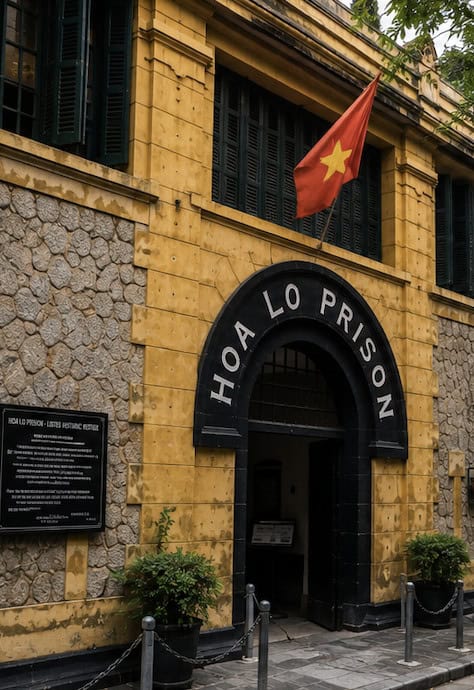
Hoa Lo Prison is a former prison in central Hanoi.
It has been preserved as a historical relic and museum. The name translates literally from Vietnamese as “fiery furnace” or “stove” — Hỏa meaning fire, Lò meaning furnace — and the site is officially listed as the Di tích Nhà tù Hỏa Lò, or Hỏa Lò Prison Relic.
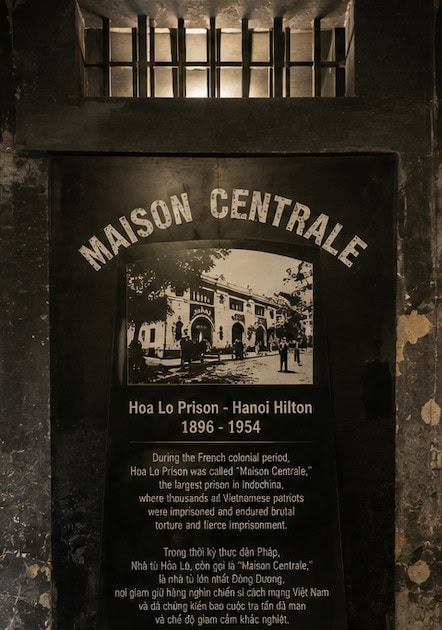
The prison was constructed by the French colonial administration in 1896 and was originally known as Maison Centrale.
It was used primarily to imprison Vietnamese political prisoners and revolutionaries who opposed French colonial rule.
During the Vietnam War, part of the prison was used to hold American pilots who had been captured after their aircraft were shot down over North Vietnam.
This second period is why the site became widely known in the United States by the nickname “Hanoi Hilton.”
Today, the preserved site presents exhibitions covering both periods, although the emphasis and interpretation reflect the Vietnamese historical perspective.
Where Is Hoa Lo Prison?
Hoa Lo Prison is located at No. 1 Hoa Lo Street in central Hanoi.
The site is in the Hoan Kiem area, making it particularly easy to combine with other central attractions.
According to the official Hoa Lo Prison visitor information, the site is approximately:
- 1.1 km from Hoan Kiem Lake
- 1.3 km from the Temple of Literature
- 850 meters from St. Joseph’s Cathedral
This makes Hoa Lo a particularly useful stop when exploring central Hanoi on foot.
Hoa Lo Prison Opening Hours
The official Hoa Lo Prison website currently lists daytime visiting hours as:
08:00–17:00 every day
The site states that it remains open during weekends, public holidays and festivals.
There is no normal midday closure, so you can visit during the middle of the day if that fits your itinerary.
Special exhibitions and evening programs can operate on different schedules, so check the current information if you specifically want a night experience.
How Much Does Hoa Lo Prison Cost?
The museum has an admission fee for daytime visits.
Because ticket prices and eligibility for reduced admission can change, check the current ticket information before your visit rather than relying on an old travel guide.
If you are planning a special evening program, do not assume that the daytime admission ticket covers it. Night tours operate as separate experiences with their own arrangements.
How Long Do You Need at Hoa Lo Prison?
For most visitors, 1–1.5 hours is enough for the main exhibition.
If you are very interested in Vietnamese history or want to read the displays in detail, allow closer to two hours.
The museum contains a considerable amount of historical information, so rushing through every room will reduce the value of the visit.
The History of Hoa Lo Prison
Understanding the two major historical periods is important before visiting.
The French Colonial Period
Hoa Lo Prison was built by the French colonial administration in 1896.
At the time, the prison formed part of a larger colonial complex in central Hanoi. It was intended to hold prisoners, including Vietnamese political prisoners and people involved in resistance movements.
The prison became associated with extremely harsh conditions.
Exhibitions at the site show the conditions in which prisoners were held and the methods of punishment used by the colonial authorities.
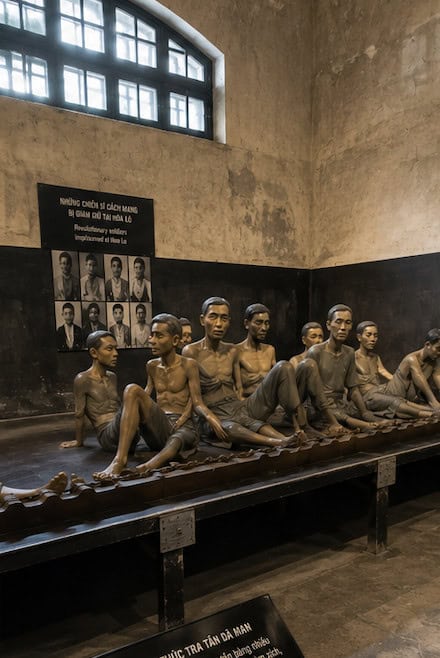
Visitors can see reconstructed and preserved areas illustrating the cramped conditions, restraints and other aspects of prison life.
Vietnamese Revolutionary Prisoners
Many Vietnamese revolutionaries were imprisoned at Hoa Lo during the colonial period.
The prison became more than simply a place of detention. According to the historical interpretation presented at the site, prisoners organized political and educational activities despite the restrictions imposed on them.
This is an important part of the museum’s story. Hoa Lo is presented not only as a place of suffering, but also as a place associated with resistance and political organization.
The Vietnam War Period
During the Vietnam War, a section of Hoa Lo Prison was used to hold American pilots captured after being shot down over North Vietnam.
This is the period most closely associated with the name “Hanoi Hilton.”
The museum presents exhibits relating to the American prisoners and their experiences at the prison.
When visiting, remember that the exhibitions are presented primarily from the Vietnamese perspective. Visitors looking for a detailed American POW history should treat Hoa Lo as one source rather than the entire historical record.
What Can You See Inside Hoa Lo Prison?
The surviving complex and exhibitions contain several different areas illustrating prison life.
Prison Cells
The cells are among the most powerful parts of the visit.
The spaces are small, enclosed and deliberately stark. They help visitors understand the physical restrictions prisoners faced rather than simply reading about them on a display panel.
Communal Prison Areas
Some areas illustrate the conditions experienced by groups of prisoners held together in confined spaces.
The displays explain how prisoners lived, ate and were restrained.
The Guillotine
One of the most striking objects associated with the site is the French colonial-era guillotine.
It is presented as evidence of the harsh methods used against prisoners during the colonial period.
This is not an attraction for visitors looking for light entertainment. Some of the material is disturbing and should be approached as historical interpretation rather than spectacle.
The Dungeon
The prison’s more severe detention areas, including cells used for solitary confinement, illustrate the extreme conditions imposed on some prisoners.
The cramped spaces and dark environment make this one of the more memorable sections of the visit.
American POW Exhibits
The museum also contains displays relating to American pilots held at Hoa Lo during the Vietnam War.
Among the best-documented individual accounts is that of John McCain, the future U.S. senator and presidential candidate, who was held at Hoa Lo after being shot down in 1967. These exhibits form a separate part of the site’s history and are important for understanding why the prison became internationally known as the “Hanoi Hilton.”
Why Is Hoa Lo Called the Hanoi Hilton?
“Hanoi Hilton” was the nickname used by American prisoners for Hoa Lo Prison during the Vietnam War.
The nickname was deliberately ironic, comparing the prison with the luxury hotel chain Hilton.
The real conditions were obviously very different.
The name became widely associated with the American POW experience in North Vietnam and remains one of the most recognizable references to the prison outside Vietnam.
Can You Visit Hoa Lo Prison Without a Guide?
Yes.
Individual visitors can enter the museum independently, and the site provides information throughout the exhibition.
For a first visit, an independent visit is perfectly reasonable because you can move at your own pace and spend more time on the subjects that interest you.
Guided experiences can be useful if you want additional historical context or a more structured explanation of the different periods.
Is Hoa Lo Prison Suitable for Children?
Older children and teenagers who are interested in history can learn a great deal from the museum.
However, parents should remember that some exhibits deal with imprisonment, torture, executions and wartime experiences.
For very young children, the subject matter may be difficult to understand or uncomfortable.
Families should decide based on the child’s age and interest in history rather than treating Hoa Lo as a standard family attraction.
Hoa Lo Prison Night Tours
Hoa Lo Prison has also developed special evening experiences that use lighting, sound and storytelling to present the site’s history.
These are considerably different from a normal daytime museum visit.
Themed programs have included experiences focused on the lives and sacrifices of Vietnamese revolutionary prisoners.
Official tourism information has described night programs running in the evening and lasting around 90 minutes, with different themes and age requirements depending on the program.
Because night-tour schedules and themes can change, check the current program directly with Hoa Lo Prison before planning your evening around one.
Rules for Visiting Hoa Lo Prison
The official visitor regulations are straightforward.
- Do not bring weapons, explosives or flammable materials.
- Large bags must be left in the designated storage area.
- Smoking is prohibited.
- Do not move or touch exhibits.
- Park only in designated areas.
- Follow instructions from museum staff.
- Incense and flowers may only be offered in the memorial area.
The most important rule is simply to treat the site as a historical memorial rather than an ordinary tourist attraction.
How to Get to Hoa Lo Prison
Because Hoa Lo is in central Hanoi, getting there is relatively easy.
Grab or taxi: This is the simplest option if you are coming from outside central Hanoi.
Walking: Hoa Lo is close enough to several major attractions to make walking practical.
Public bus: The official visitor information lists bus connections from several parts of central Hanoi.
If you are already exploring Hoan Kiem Lake and the Old Quarter, walking is often the most convenient option.
Hoa Lo Prison and Temple of Literature
These two attractions make a particularly good combination.
The Temple of Literature is approximately 1.3 km from Hoa Lo Prison, making it possible to visit both during the same half-day.
Start at the Temple of Literature, then walk toward Hoa Lo Prison through central Hanoi.
Our Temple of Literature Hanoi guide covers the history, courtyards, opening information and visitor tips for the first part of this route.
Hoa Lo Prison and the Old Quarter
Hoa Lo is also easy to combine with an Old Quarter walking route.
After visiting the prison, you can walk toward Hoan Kiem Lake and continue into the Old Quarter.
This works particularly well because the two areas provide completely different experiences: Hoa Lo focuses on history and memory, while the Old Quarter shows the everyday commercial and social life of Hanoi.
Our Hanoi Old Quarter Walking Guide provides a practical route through the historic streets.
Hoa Lo Prison and Hanoi Museums
Hoa Lo is already part of our wider guide to the Best Museums in Hanoi.
However, it deserves separate attention because it is more than a conventional museum. The surviving prison environment makes the experience much more physical and immediate than many of Hanoi’s other historical collections.
How to Plan a Historical Day in Hanoi
If you want to spend a day focusing on Hanoi’s history, there are several ways to combine the attractions.
One option is:
- Ho Chi Minh Mausoleum and Ba Dinh Square
- Ho Chi Minh Museum
- Temple of Literature
- Hoa Lo Prison
- Hoan Kiem Lake
- Old Quarter
This is a demanding day, so do not try to rush through every attraction.
A more relaxed option is to choose two or three major sites and leave enough time to actually understand what you are seeing.
Our Ho Chi Minh Mausoleum guide explains how to plan the Ba Dinh portion of the day.
Is Hoa Lo Prison Worth Visiting?
Yes, particularly if you are interested in Vietnamese history.
Hoa Lo is one of the few places in Hanoi where you can physically enter a preserved former prison and see the environment in which political prisoners were held.
The museum also provides an opportunity to learn about the complicated history of the Vietnam War from the Vietnamese perspective.
It is not a light or entertaining attraction, but that is precisely why it can be one of the most memorable historical experiences in Hanoi.
Hoa Lo Prison: Practical Tips
- Allow at least 1–1.5 hours.
- Wear comfortable shoes.
- Read the exhibition descriptions rather than rushing through the rooms.
- Expect some disturbing historical material.
- Keep your belongings secure and follow the museum’s storage rules.
- Check the current schedule if you want a night tour.
- Combine Hoa Lo with the Temple of Literature or Old Quarter.
- Do not touch exhibits or historical objects.
FAQ
What is Hoa Lo Prison famous for?
Hoa Lo Prison is famous for its history as a French colonial prison for Vietnamese political prisoners and for its later use during the Vietnam War to hold American pilots. It became internationally known by the nickname “Hanoi Hilton.”
What are Hoa Lo Prison opening hours?
The official visitor information currently lists opening hours from 08:00 to 17:00 every day, including holidays.
How long does Hoa Lo Prison take?
Allow around 1–1.5 hours for a normal visit. Visitors who want to read the exhibitions in detail may want closer to two hours.
Can tourists visit Hoa Lo Prison?
Yes. Individual visitors can visit the historical relic during its normal opening hours.
Is Hoa Lo Prison the real Hanoi Hilton?
Yes. “Hanoi Hilton” was the nickname American prisoners used for Hoa Lo Prison during the Vietnam War.
Can children visit Hoa Lo Prison?
Yes, but parents should consider the subject matter. Some exhibitions deal with imprisonment, torture, executions and wartime experiences, making the site more suitable for older children and teenagers.
Can you visit Hoa Lo Prison at night?
Special night-tour programs have been offered at Hoa Lo Prison. They are separate experiences from the normal daytime visit and should be checked in advance because schedules and themes can change.
Is Hoa Lo Prison worth visiting?
Yes. It is one of Hanoi’s most important historical sites and provides a much deeper understanding of Vietnam’s colonial and wartime history.
More from our travel guide network
Build your Vietnam route — free.