Most visitors to Nha Trang stop at the Stone Church on Thái Nguyên, snap a photo, and leave.
Five kilometers southeast of the city center, on Võ Thị Sáu Street, lies a quieter Catholic parish.
Thanh Gia Parish Nha Trang, the Holy Family Parish, was born from war and abandoned before its church was finished.
It was demolished, rebuilt, and consecrated in its current form a few years ago.
It’s not a museum.
It’s a living community of about a thousand people, carrying seventy years of displacement and quiet faith.
If you’re checking flights to Nha Trang, this offers history that feels real.
It’s a short drive.
🕊️ Born from a Divided Country
The year is 1954. The Geneva Accords have just split Vietnam in two, and across the country, people are moving. Among them are soldiers from the Bùi Chu – Phát Diệm engineer battalion, stationed in the Chụt area — what is now Vĩnh Nguyên ward. These were Catholic men, far from home, surrounded by other displaced families. The bishop in Nha Trang saw the need and sent a priest, Father Phêrô‑Tuần Nguyễn Cao Hiên, to look after this growing community of migrants.
In 1955, the parish was officially born. Father Hiên cleared land in Trường Tây village and began building — a church, a school. But before the church could be plastered and the school finished, the battalion was transferred. The priest was recalled to Saigon. Most of the congregation scattered. The first Thanh Gia church was never completed. It stood, unfinished, as a monument to a community that had already moved on. 🧱
📍 The Church That Moved — Twice
That first building was called Chụt Church – Cầu Đá, about a kilometer southeast of where the parish stands today, near the Petrolimex depot. For nearly a decade, it served the faithful who remained. But in 1964, the site was demolished. The congregation, once again, had to move.
Negotiations with the government led to the purchase of a new, much larger plot — 10,500 square meters — from the Redemptorist order. Construction on the second church began in August 1964. By September 1967, the building was mostly complete, but it lacked a proper front facade and a bell tower. It was a church, but an incomplete one, standing as a quiet reminder that this parish had never quite had the chance to finish what it started.
For decades, that second church served the community.
It stood through the war, through the fall of Saigon, and through rebuilding.
But by the early 2000s, it had decayed.
In December 2003, the foundation stone for a third church was laid.
Construction took sixteen years — a full generation — and on January 12, 2020, the current sanctuary was finally consecrated.
Almost exactly sixty years after the first church was demolished, Thanh Gia Parish Nha Trang finally had its permanent home 🏛️
🙏 What Stands Here Today
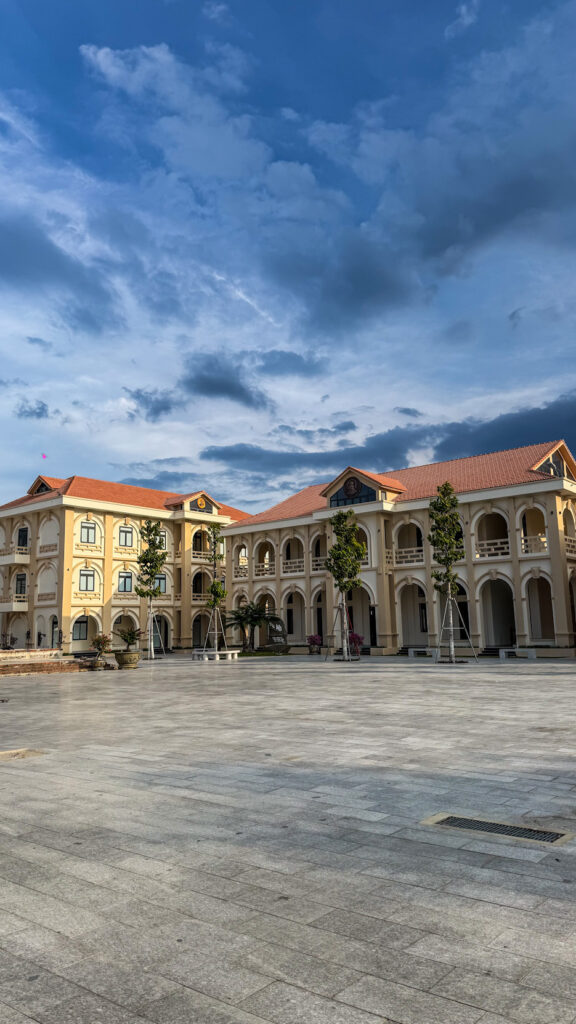
The current church is large, simple, and dignified. Modern stained glass casts colored light across the pews, and the high ceiling creates a sense of space and calm. The architecture is a departure from the French Gothic style of the Stone Church — here the lines are cleaner, the atmosphere more open. A quiet courtyard with mature trees surrounds the building, providing shade and a sense of peace that feels far removed from the busy streets of central Nha Trang.
This is an active congregation of about 1,000 parishioners. Unusually, the parish even covers two islands — Trí Nguyên and Bích Đầm — meaning the pastoral reach of this church extends beyond the mainland and out into the bay. Mass is held on Sundays at 5:30 AM, 7:40 AM, and 2:30 PM, and on weekdays at 4:30 AM and 5:30 PM. The patron saint is the Holy Family, with a feast day on December 31, celebrated around Christmas. If you visit during that season, you’ll see the parish at its most vibrant. 🎄
📍 Practical Info
📍 Address: 48 Võ Thị Sáu, Phước Long, Nha Trang
📞 Phone: 0258 3883 809
🕒 Mass times: Sundays 5:30 AM, 7:40 AM, 2:30 PM; weekdays 4:30 AM & 5:30 PM
👗 Dress code: Shoulders and knees covered — this is an active place of worship
🚕 Getting there: About 5 km southeast of the city center, a 10–15 minute Grab ride
The church sits on Võ Thị Sáu Street, not far from the coastal road. After your visit, you can easily combine it with a stop at the Dòng Thánh Giuse monastery, which is on the same street and shares a similar refugee history. For a comfortable base nearby, my Top 10 Best Hotels in Nha Trang guide can help — staying in the southern part of the city puts you within easy reach of both these hidden gems and the quieter stretches of the coast.
🔗 What to Pair It With
Thanh Gia Parish is part of a larger story of Catholic migration that shaped Nha Trang in the 1950s. Two other nearby landmarks share this history: Khiết Tâm Church, founded by northern refugees in 1956 just a short drive north, and the Dòng Thánh Giuse monastery, which moved its headquarters to Nha Trang in 1955 to serve the same displaced communities. Visiting all three in a single morning paints a powerful picture of how war reshaped this city. For a completely different kind of quiet, my peaceful pagoda guide offers Buddhist stillness under a 100-year-old Bodhi tree. 🌿
💎 Verdict: A Living Story, Not a Tourist Stop
Thanh Gia Parish doesn’t appear on postcards. It doesn’t have a viewpoint, a gift shop, or a bus parking zone. What it has is seventy years of displacement, demolition, and rebuilding — and a congregation of a thousand people who still gather here every week. Come for the history, stay for the silence, and leave with the sense that you’ve found something real. ⛪
Frequently Asked Questions
What is the history of Thanh Gia Parish in Nha Trang?
It was founded in 1955 to serve Catholic soldiers displaced after the 1954 Geneva Accords split Vietnam, but the original church was never completed because the battalion was transferred and the priest recalled to Saigon.
How many times has Thanh Gia Parish’s church building moved or been rebuilt?
The church has been rebuilt three times — the first was demolished in 1964, the second (1964–1967) was incomplete and lacked a facade and bell tower, and the current, third church was consecrated on January 12, 2020.
How long did it take to build the current Thanh Gia church?
Construction on the third church began in December 2003 and took sixteen years, finally being consecrated in January 2020.
Where is Thanh Gia Parish located in Nha Trang?
It’s about five kilometers southeast of the city center on Võ Thị Sáu Street.
How large is the Thanh Gia Parish community today?
It’s a living community of about a thousand people, carrying seventy years of displacement and quiet faith.
Disclosure: This article contains affiliate links. If you book through them, I may earn a small commission at no extra cost to you. I only recommend places I have personally visited and trust.
More from our travel guide network
Build your Vietnam route — free.