Most visitors to Ho Chi Minh City end their history tour at the Independence Palace. They walk through the president’s office, see the Huey helicopter on the rooftop, and leave thinking they’ve seen the full story.
🗺️ A Single Room, a Single Mission
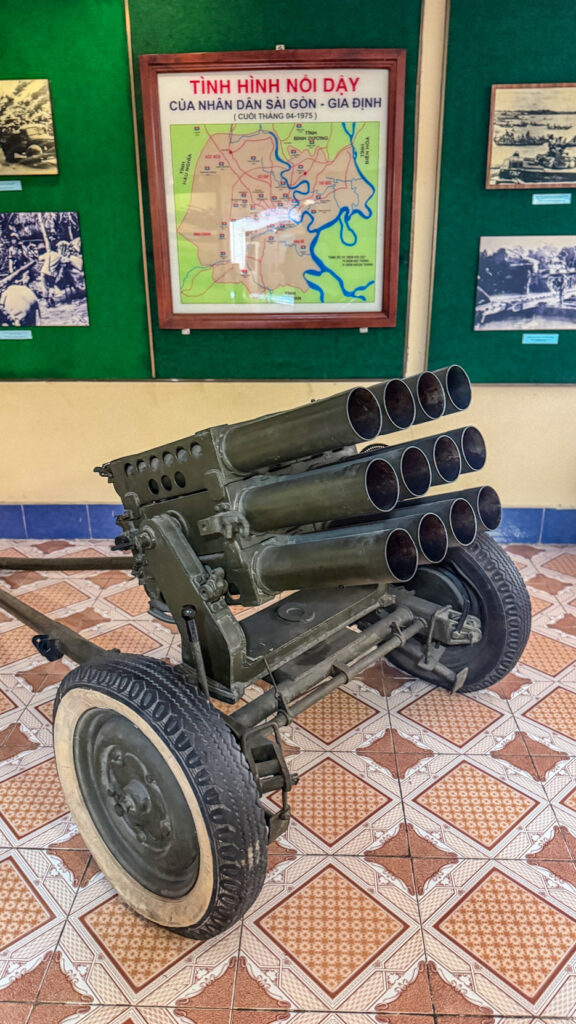
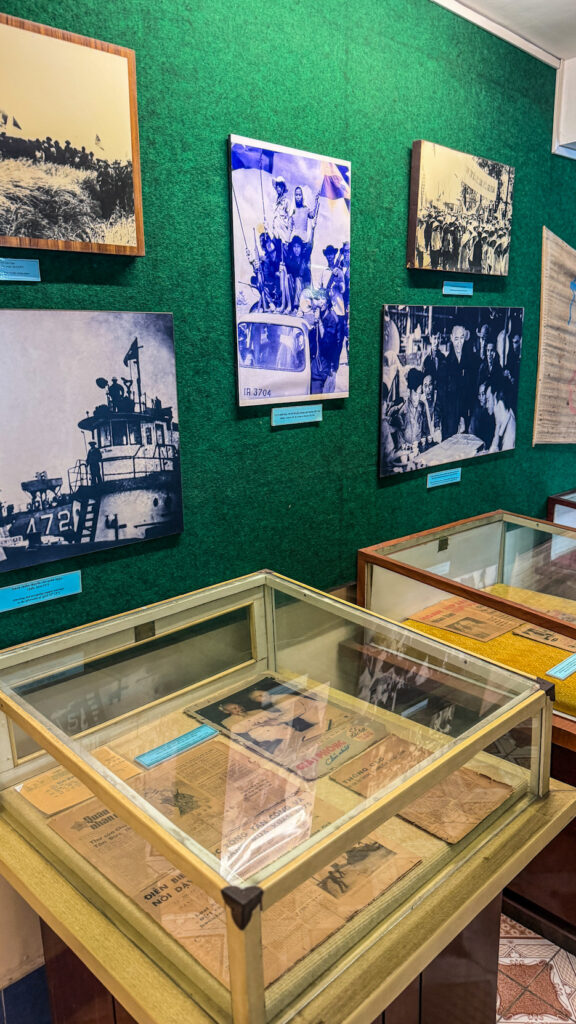
The museum occupies one modest room in a low, quiet building separated from the main colonial mansion by a courtyard of bronze bells and ancient trees. Walk in, and you’re immediately surrounded by maps. Large, wall-sized tactical diagrams show the progression of the Ho Chi Minh Campaign — the arrowheads sweeping south from the Central Highlands, the pincer movements encircling Saigon, the final thrust into the city. These are not abstract graphics. They’re detailed operational plans, marked with unit numbers, dates, and the names of commanders who led real soldiers into real battles. The maps are accompanied by black-and-white photographs taken during the campaign: soldiers crossing rivers on bamboo rafts, tanks rolling through jungle clearings, civilians greeting the advancing troops with flags and flowers. The graininess of the images makes the events feel both distant and immediate, like a family album from a moment you weren’t supposed to see. 📸
🪖 The Generals, the Soldiers, and the Radio
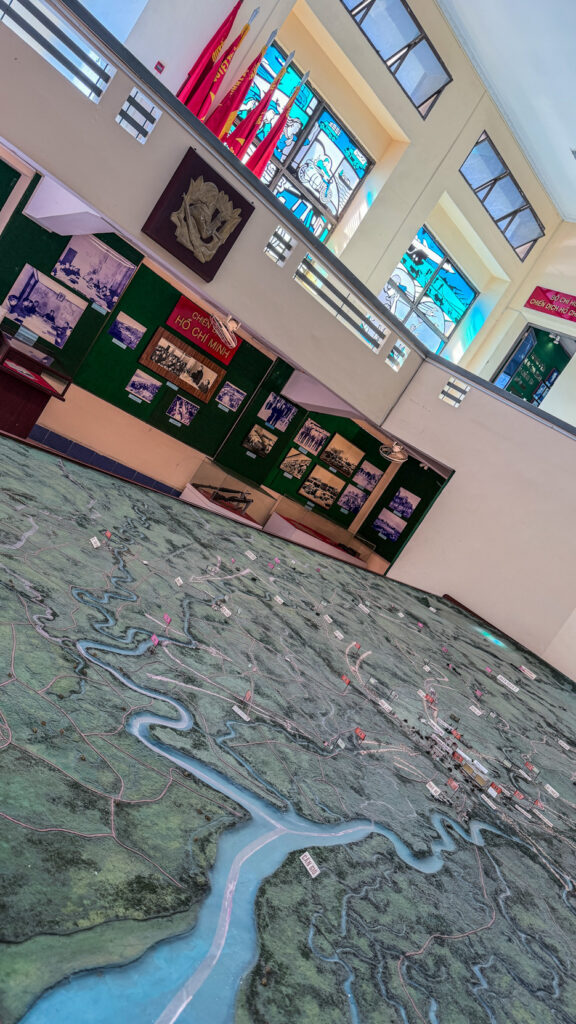
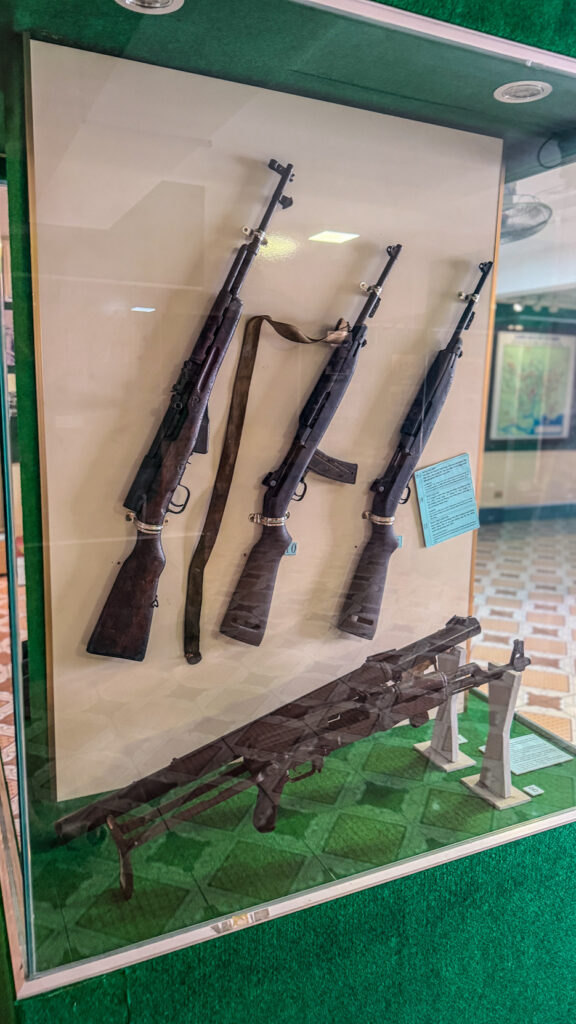
At the centre of the room stands a large diorama — a three-dimensional model of the battlefield dotted with miniature tanks, artillery pieces, and troop formations. It’s the kind of exhibit that draws you in close, making you trace the routes with your finger, imagining the terrain and the distances involved. Around the diorama, glass cases hold the personal belongings of soldiers and officers: worn leather boots, a compass, a battered canteen, identity cards with youthful faces that don’t match the weight of what those faces lived through. One case displays a field radio, its metal casing scratched and dented, the kind of equipment that would have crackled with orders during the final hours. Another holds a collection of medals and ribbons awarded after the campaign, their bright enamel contrasting with the faded uniforms beside them. These are not grand, heroic objects. They’re small, intimate, human — and that’s exactly what makes them so powerful. 🥾
🏛️ The Room Where the War Ended, and the Room That Explains How It Got There
What makes the Campaign Museum genuinely valuable is its focus. Unlike the War Remnants Museum, which covers the entire conflict from multiple perspectives, this museum does one thing and does it with precision: it tells the story of the military operation that ended the war. The narrative is chronological, starting with the Politburo’s decision in March 1975 to launch the final offensive and ending with the iconic photograph of a tank crashing through the gates of the Independence Palace. Along the way, you’ll see portraits of the campaign’s key commanders — Văn Tiến Dũng, Lê Đức Anh, Lê Trọng Tấn — men whose strategic decisions are still studied in military academies today. The captions are bilingual, and while the language is sometimes formal, the information is dense and rewarding. This is a museum for people who want to understand how wars end — not just that they do. 📜
📍 Practical Info
📍 Address: 2 Lê Duẩn, Bến Nghé Ward, District 1, Ho Chi Minh City
🕒 Opening hours: Check the current opening hours before visiting, as they may change.
🎟️ Entrance: Free.
👗 Dress code: Casual, but it’s a war memorial — show the respect you would at any military site.
🚕 Getting there: The museum is located on Lê Duẩn in central Ho Chi Minh City. When using Grab, enter the museum’s name or address directly to avoid being taken to the Museum of Ho Chi Minh City on Lý Tự Trọng.
You can find a hotel in Ho Chi Minh City near Bến Nghé Ward — staying in District 1 puts you within walking distance of this museum, the City Museum, the Fine Arts Museum, and the Independence Palace. For the highest-rated stays across all budgets, my Top 10 Best Hotels in Ho Chi Minh City guide has the full lineup.
🔗 What to Pair It With
The Museum of Ho Chi Minh City is a separate museum at a different location, so plan it as a separate stop rather than combining the two as one museum visit. For a completely different kind of war memory, the Southern Women’s Museum offers another perspective on Vietnam’s wartime history. If you want to continue your historical tour, the Independence Palace is another major historical site in central Ho Chi Minh City.
Frequently Asked Questions
What does the Ho Chi Minh Campaign Museum in Saigon cover?
It focuses specifically on the military operation that ended the Vietnam War — the Ho Chi Minh Campaign — using wall-sized tactical maps, photographs, a battlefield diorama, and soldiers’ personal belongings.
Is the Ho Chi Minh Campaign Museum free to visit?
Yes, it’s free, and it’s located in a modest room in a low building separated from the main Independence Palace by a courtyard.
How is the Campaign Museum different from the War Remnants Museum?
While the War Remnants Museum covers the entire conflict from multiple perspectives, the Campaign Museum focuses narrowly and chronologically on the final military operation that ended the war, from the March 1975 Politburo decision to the fall of the Independence Palace.
What can you see inside the Campaign Museum?
Large tactical maps of the Ho Chi Minh Campaign, black-and-white wartime photographs, a diorama of the battlefield, and glass cases with soldiers’ personal items like boots, a compass, and a field radio.
Where is the Ho Chi Minh Campaign Museum located?
It’s a separate room near the Independence Palace, reached through a courtyard of bronze bells and old trees — most visitors miss it because they stop their tour at the Palace itself.
More from our travel guide network
Build your Vietnam route — free.