Vietnam travel budget depends on your accommodation, food, transport and activities. Start with a daily spending plan in VND, then add visas, flight tickets for your dates, intercity travel and a contingency fund separately. This guide covers how much money to take to Vietnam, a daily budget for Vietnam, a Vietnam backpacking budget, how much a trip to Vietnam costs and whether Vietnam is cheap to travel.
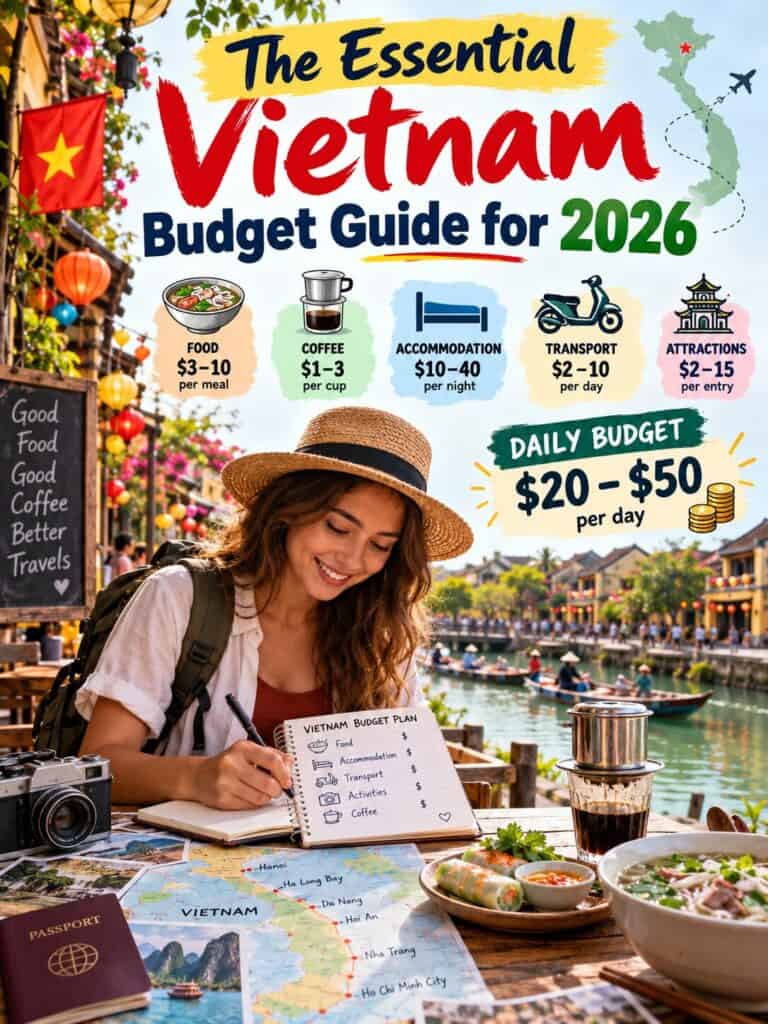
Backpackers can get by on $25–$35 USD (hostel, street food, buses).
Luxury travelers should budget $100–$150+ USD per day (resorts, fine dining, private tours).
For 14 days, multiply your chosen daily budget by 14. Add international flights, visas, private airport transfers and travel insurance if they are not already included.
This Vietnam travel budget guide separates routine daily spending from one-off trip costs. Prices vary by destination, season, room occupancy and booking date.
💵 Vietnam’s Currency: The Dong (VND)
Vietnam’s official currency is the Vietnamese Dong (VND). Banknotes range from 1,000 VND (worth about $0.04 USD) to 500,000 VND (about $20 USD). There are no coins in circulation.
Exchange rates change daily. Convert VND amounts using your card issuer’s or exchange provider’s actual rate, including applicable fees.
Vietnam uses the dong (VND). Availability of VND exchange abroad varies by country and provider. You can exchange money through authorized providers or withdraw VND at an ATM after arrival.
🏨 Accommodation Costs (Per Night)
Hostel: $5–$15 USD (120,000–350,000 VND) — dorm bed, basic amenities, social atmosphere
Budget hotel: $15–$30 USD (350,000–700,000 VND) — private room, ensuite, often includes breakfast
Mid-range hotel: $30–$70 USD (700,000–1,700,000 VND) — comfortable room, good location, pool possible
Luxury resort: $100–$300+ USD (2,500,000–7,500,000+ VND) — high-end amenities, beachfront, private pools
Note: Phu Quoc and Nha Trang have a wider range than smaller cities. For detailed options, check out my guides to hotels on Phu Quoc, hotels in Da Nang, and hotels in Nha Trang, or see the full Vietnam hotel prices guide for a city-by-city breakdown.
🍜 Food Costs (Per Day)
Street food: $2–$5 USD (50,000–120,000 VND) — phở, bánh mì, bún chả, fresh spring rolls
Local restaurant: $5–$10 USD (120,000–250,000 VND) — sit-down meal, rice/noodle dishes, seafood
Mid-range restaurant: $10–$20 USD (250,000–500,000 VND) — Western or upscale Vietnamese options
Fine dining: $25–$50+ USD (650,000–1,300,000+ VND) — resort restaurants, tasting menus
Beer (local): $0.50–$1.50 USD (12,000–35,000 VND) — Saigon, Hanoi, Larue, Bia Hoi draft
Coffee (Vietnamese): $1–$2 USD (25,000–50,000 VND) — cà phê sữa đá (iced coffee with condensed milk)
🚗 Transport Costs
Airport transfer (Hanoi/Saigon): $10–$15 USD (250,000–380,000 VND) — taxi or Grab
Grab (ride-hailing): $0.50–$3 USD (12,000–75,000 VND) — short rides within cities
Bus (local): $0.30–$0.50 USD (7,000–12,000 VND) — within cities
Train (Hanoi–Ho Chi Minh City): fares vary by train, berth class and departure date; check the exact train before adding this long-distance journey to your budget.
Bus (intercity): $10–$20 USD (250,000–500,000 VND) — overnight sleeper buses
Domestic flight: $50–$100+ USD (1,250,000–2,500,000+ VND) — depending on route and booking time
Motorbike rental: $5–$10 USD (125,000–250,000 VND) — per day, fuel extra
🎟️ Activities & Entry Fees
Museum entry: $1–$3 USD (25,000–75,000 VND) — most museums in Hanoi, Saigon, Da Nang
Pagoda/temple: Free – $2 USD (50,000 VND) — most are free or ask for small donation
Ha Long Bay cruise (1 day): $30–$60 USD (750,000–1,500,000 VND) — includes lunch and activities
Hon Thom cable car: $30–$35 USD (700,000–850,000 VND) — round-trip, includes Aquatopia
VinWonders Phu Quoc: $38–$40 USD (950,000–1,000,000 VND) — theme park entry
Mud bath (Nha Trang): $10–$20 USD (250,000–500,000 VND) — depending on package
Snorkeling tour (Phu Quoc): $15–$30 USD (380,000–750,000 VND) — half-day, includes gear
Check the attraction’s current ticket conditions before including it in your daily allowance. Packages, age categories and included services can change the total.
📱 SIM & Internet Costs
SIM card: check the operator’s current package for validity, total data allowance, daily caps, calls and registration requirements. Not every tourist SIM includes unlimited calls.
eSIM (30 days): $8–$15 USD (200,000–380,000 VND) — convenient, no physical card needed
💰 Sample Daily Budgets (Per Person)
Backpacker ($25–$35/day):
- Accommodation: $10–$15 (hostel/budget hotel)
- Food: $5–$8 (street food, local eats)
- Transport: $2–$5 (buses, short Grab rides)
- Activities: $5–$10 (entry fees, one paid activity)
Mid-range Vietnam daily budget: build the total from your accommodation share, meals, local transport and scheduled activities.
Use the same currency for all four categories, and check that their sum matches your stated daily budget.
- Accommodation: $25–$40 (mid-range hotel)
- Food: $10–$15 (local restaurants, some Western options)
- Transport: $5–$10 (Grab, occasional intercity bus)
- Activities: $10–$15 (tours, entry fees, experiences)
Luxury ($100–$150+/day):
- Accommodation: $60–$120+ (resort, boutique hotel)
- Food: $20–$40+ (fine dining, resort restaurants)
- Transport: $10–$20+ (private transfers, flights)
- Activities: $20–$40+ (private tours, premium experiences)
Vietnam Travel Budget: 7-Day and 14-Day Comparison
The following are planning scenarios. Choose a daily allowance, multiply by travel days, then add major costs excluded from the allowance.
| Daily allowance | 7 days / person | 14 days / person | 14 days / 2 people |
|---|---|---|---|
| 600,000 VND | 4,200,000 VND | 8,400,000 VND | 16,800,000 VND |
| 1,200,000 VND | 8,400,000 VND | 16,800,000 VND | 33,600,000 VND |
| 2,500,000 VND | 17,500,000 VND | 35,000,000 VND | 70,000,000 VND |
These amounts assume the allowance already includes accommodation, food, local transport and routine activities. International flights, visas, insurance and exceptional tours are excluded. The two-person column doubles individual spending; sharing a room can reduce actual lodging costs.
Vietnam Backpacking Budget: A Worked Daily Example
| Expense | Illustrative amount |
|---|---|
| Hostel bed | 300,000 VND |
| Two street-food meals | 90,000 VND |
| Coffee | 25,000 VND |
| Local transport | 75,000 VND |
| Activities and extras | 110,000 VND |
| Total | 600,000 VND |
The 300,000 VND hostel, 45,000 VND meal and 25,000 VND coffee are published tourism-board price examples, not live quotes. Transport and activities are allocations selected to illustrate the arithmetic.
🏧 ATMs & Card Payments
ATMs are common in cities and tourist areas. Withdrawal limits and fees depend on the machine and card issuer. The national tourism website gives illustrative per-transaction limits of 2–3 million VND at some local banks and 5–10 million VND at some international banks. Check the ATM screen before accepting a fee.
No bank can be recommended universally as fee-free: ATM surcharges and issuer charges depend on your card and the specific machine.
Local banks with good coverage: Vietcombank, BIDV, Techcombank
Cards: Credit and debit cards are accepted at hotels, high-end restaurants, and large stores. Cash is still king for street food, taxis, and local shops. Always carry some cash.
How Much Cash Should You Carry in Vietnam?
Keep enough VND for the next day’s small purchases and transport rather than carrying your entire trip budget. At a 600,000 VND daily allowance, a two-day cash reserve is 1,200,000 VND. If you mainly pay hotels by card, adjust the reserve to cover only cash expenses.
Some terminals offer to charge you in your home currency. Compare the offered conversion with your card issuer’s rate before choosing; the displayed rate can be less favorable.
💵 Bringing Cash: How Much in USD?
Recommended approach: Bring $100–$200 USD per person as emergency cash. Exchange it at gold shops or banks for better rates than airports. You can also use ATMs to withdraw VND as you go — better rates than exchanging physical cash in many cases.
Compare the net VND amount after fees at authorized banks and exchange counters. Airport and hotel rates may differ, but no provider is always cheapest.
📌 Money-Saving Tips
- Eat street food — it’s not just cheap, it’s often the best food in the country.
- Use Grab instead of taxis — cheaper and no haggling.
- Book tours and tickets online — often cheaper than buying at the counter, especially for VinWonders and Hon Thom.
- Travel in the shoulder season — March–May or September–November for lower prices and fewer crowds.
- Stay in mid-range hotels — the jump from budget to mid-range is small, but the quality increase is huge.
- Use local buses instead of tourist shuttles — a fraction of the price.
- Bargain at markets — but do it politely and don’t push too hard.
Costs Often Missing From a Vietnam Travel Budget
| Expense | How to budget |
|---|---|
| E-visa, if required | US$25 single entry or US$50 multiple entry (official government fee) |
| International flights | Use an actual itinerary and travel dates |
| Internal flights or sleeper trains | Add each confirmed fare separately |
| Travel insurance | Use a quote for your age, country of residence and activities |
| Checked baggage and transfers | Check what your ticket includes |
| Emergency reserve | Keep separate from expected daily spending |
If your hotel is quoted per room, divide its cost by the number of people sharing. Do not divide meals, admission tickets or individual transport fares by two.
Is Vietnam Cheap? Compare Actual Spending, Not Labels
A 700,000 VND hotel room costs 350,000 VND per person when two travelers share it. The same room costs 700,000 VND per person for a solo traveler. This difference can matter more than small savings on food.
⚠️ Tipping in Vietnam
Tipping is not mandatory in Vietnam, but it’s appreciated. Here are general guidelines:
- Restaurants: 5–10% if service charge isn’t included. Many nicer places add a 5–10% service charge automatically — check the bill.
- Taxi drivers: Round up to the nearest 10,000–20,000 VND.
- Hotels: 20,000–50,000 VND for bellhops and housekeeping.
- Tours: 100,000–200,000 VND per person for a full-day tour guide.
Vietnam Travel Budget: Real Price Benchmarks
Vietnam’s national tourism website publishes illustrative amounts of 45,000 VND for a street-food meal with iced tea, 55,000 VND for a café cappuccino, 300,000 VND for a budget hostel and 700,000 VND for a mid-range hotel. It also lists 350,000 VND for a one-hour foot massage and 1,000,000 VND for a half-day group tour. These are reference examples, not guaranteed rates in every city.
💎 Final Verdict
Vietnam is one of Southeast Asia’s best-value destinations. A comfortable mid-range trip costs –70 USD per day — less than most European or US cities. With careful planning, you can enjoy excellent food, great accommodation, and memorable activities without breaking the bank.
🏨 Where to Stay & What to Pair It With
Once you’ve sorted your budget, it’s time to book your accommodation. You’ll find everything from budget guesthouses to luxury resorts across Vietnam — check hotels in Vietnam to compare prices and read guest reviews. For a broader overview, I’ve put together guides to the best hotels on Phu Quoc, best hotels in Da Nang, and best hotels in Nha Trang if you’re still deciding where to base yourself.
Pair your trip with a visit to Ngoc Hien Pearl Farm for a unique cultural experience, or Sim Sơn Winery for a taste of Phu Quoc’s famous sim wine. For a full day of adventure, combine it with VinWonders and Safari — the park is one of the island’s top attractions.
Frequently Asked Questions
How Much Money to Take to Vietnam in Cash?
A common recommendation is $100-200 USD in cash as an emergency buffer, since the Vietnamese Dong is a non-convertible currency you can’t buy outside the country — you’ll exchange USD or EUR locally or withdraw VND from ATMs after arrival.
Is Vietnam Cheap to Travel With a Fixed Daily Allowance?
Yes, if your accommodation and transport fit your daily allowance. Use the tables above to calculate your total in VND, then convert at the current rate.
How Do ATM Fees Affect a Vietnam Backpacking Budget?
Fees and limits vary by ATM and card issuer. Check the amount, fee and exchange-rate option on the screen before confirming.
What Is a Realistic Vietnam Travel Budget Per Day?
Backpackers can get by on $25-35 USD per day, a comfortable mid-range budget is $50-70 USD per day, and luxury travelers should plan for $100-150+ USD per day. A two-week mid-range trip works out to roughly $700-1,000 USD per person.
Can I use credit cards in Vietnam, or do I need cash?
Credit and debit cards are accepted at hotels, high-end restaurants, and large stores, but cash is still essential for street food, taxis, and local shops — it’s worth always carrying some VND.
More on Money in Vietnam
For more on handling cash, see my guides on the best ATMs in Vietnam, cash or card in Vietnam, and where to exchange money.
Build your Vietnam route — free.