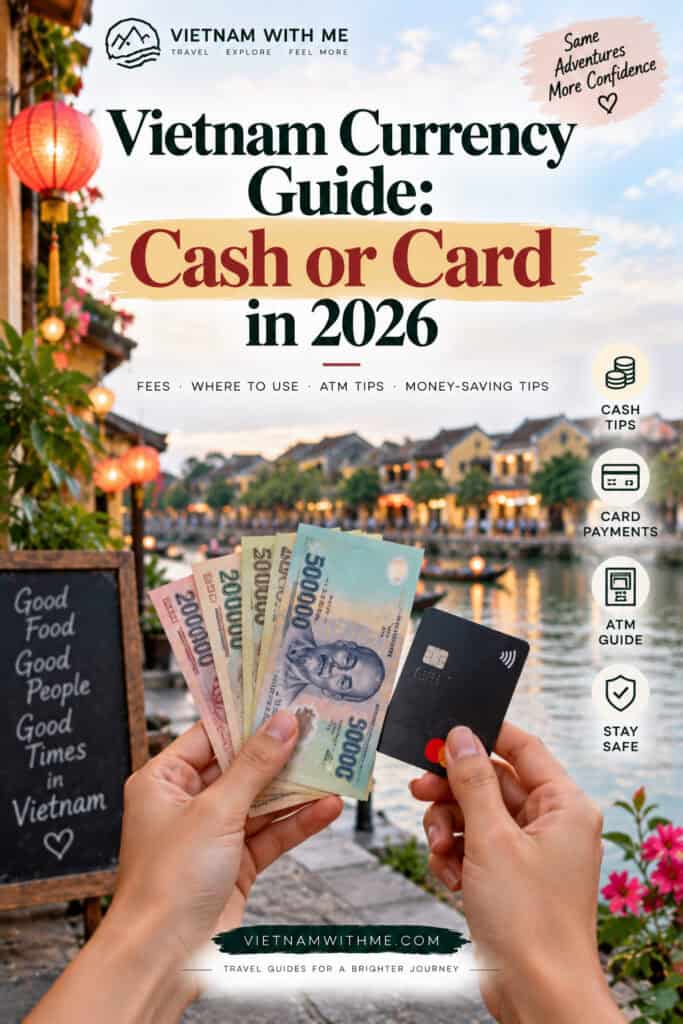
Knowing where to exchange money in Vietnam can save you from unnecessary fees, poor exchange rates and the stress of trying to find cash after you arrive.
Vietnam is still a country where cash is useful, especially for small restaurants, markets, street food, local transport and smaller businesses. At the same time, cards are widely accepted at hotels, restaurants, supermarkets, tour operators and other businesses in tourist areas.
So where should you actually exchange your dollars, euros or other foreign currency?
The short answer is: you have several options, but they are not equally convenient. Airports are useful for a small emergency amount, banks are straightforward and regulated, while official exchange counters can be convenient when you want to exchange physical foreign currency in the city.
This guide explains the practical differences and how to avoid making an expensive exchange simply because you are in a hurry.
If you are planning your first trip, you may also want to read our Vietnam Currency: Cash or Card guide.
Where Can You Exchange Foreign Currency in Vietnam?
Tourists can generally exchange foreign currency through legitimate banks and authorized currency exchange facilities.
Vietnam Tourism specifically lists currency exchange counters at airports, banks and official exchange centres.
Your main options are:
- banks;
- authorized currency exchange counters;
- airport exchange counters;
- other officially authorized exchange facilities.
You can also get Vietnamese dong from an ATM using an international debit or credit card. For many travellers, this is actually the easiest way to obtain an initial amount of cash.
Should You Exchange Money at the Airport?
Yes, but there is an important distinction between exchanging some money at the airport and exchanging your entire travel budget there.
Vietnam’s international airports have currency exchange facilities, and ATMs are also available.
If you land without any Vietnamese dong, exchanging a small amount at the airport can be perfectly reasonable.
For example, you may need money for:
- food and drinks;
- a small purchase;
- transport;
- emergency expenses.
There is usually no reason to exchange thousands of dollars immediately after landing, however.
Once you reach your destination, you will have more time to compare your options.
Airport Exchange vs ATM
For many travellers, the real question is not whether to exchange cash at the airport but whether to exchange cash at all.
If you have an international bank card, an ATM may be more convenient.
Vietnam Tourism currently recommends that many travellers use ATMs rather than relying on currency exchange points.
The advantage is simplicity: you withdraw Vietnamese dong directly instead of carrying a large amount of foreign currency around and looking for an exchange counter.
However, ATM withdrawals can involve fees from the Vietnamese bank, your own bank, or both. Your card may also have its own foreign-currency conversion rules.
That means you should compare the total cost rather than assuming that an ATM is automatically cheaper.
Where Is the Best Place to Exchange Money in Vietnam?
There is no single exchange location that is always the cheapest.
The rate can vary depending on:
- the currency you are exchanging;
- the amount;
- the exchange provider;
- the current market rate;
- any commission or additional fee.
A useful way to compare offers is to look at how many Vietnamese dong you will actually receive for your foreign currency.
Do not look only at a large number displayed on a board. Ask how much VND you will receive for the exact amount you want to exchange.
Exchanging Money at a Vietnamese Bank
Banks are one of the most straightforward choices if you want a conventional and clearly regulated place to exchange foreign currency.
The process can be less convenient than walking into a small exchange counter, however.
You may need to provide your passport or other identification, and opening hours are generally more limited than those of airport facilities or some exchange counters.
For a traveller who wants a simple, formal option and is not in a hurry, a bank can be a good choice.
Can Tourists Exchange Money at Currency Exchange Counters?
Yes. Official exchange counters are a common option for tourists who are carrying foreign cash.
Vietnam Tourism lists official exchange centres alongside banks and airport exchange counters as places where travellers can exchange money.
The important word is official.
Do not simply hand your money to an individual offering a better rate on the street.
Use an authorized exchange facility and check the amount you are receiving before walking away.
What About Gold Shops?
You may see older travel guides recommending particular gold shops or jewellery businesses as the best places to exchange money.
This advice needs to be treated carefully.
Vietnam’s foreign-exchange rules apply to businesses that provide currency-exchange services, so tourists should use facilities that are legally authorized to conduct the relevant transaction.
Do not assume that a jewellery or gold shop can legally exchange foreign currency simply because another traveller recommended it online.
If a business is not clearly authorized to provide the exchange service, choose a bank or an authorized exchange facility instead.
What Foreign Currency Can You Exchange in Vietnam?
US dollars, euros and several other major currencies are commonly handled by Vietnamese banks and exchange facilities.
However, availability and rates can vary by location.
If you are carrying a less commonly traded currency, it can be worth checking in advance whether the bank or exchange facility accepts it.
For major currencies, you will generally have more options in Hanoi, Ho Chi Minh City, Da Nang and other major tourist destinations.
Are Old or Damaged Banknotes Accepted?
This is particularly important if you are travelling with US dollars.
Exchange facilities can be selective about the physical condition of foreign banknotes.
A heavily damaged, torn or badly marked note may be refused or receive a less favourable rate.
For this reason, bring clean and undamaged banknotes whenever possible.
Do not deliberately bring old, heavily worn notes simply because you have them left over from another trip.
Should You Bring US Dollars to Vietnam?
You can bring foreign currency and exchange it into Vietnamese dong, but you do not need to convert your entire travel budget into US dollars simply because you are travelling to Vietnam.
The most practical combination for many travellers is:
- one or more international payment cards;
- some emergency cash;
- access to an ATM;
- a small amount of Vietnamese dong for immediate expenses.
This gives you several ways to pay instead of depending entirely on one method.
How Much Cash Should You Exchange?
That depends on your travel style.
You may need more cash if you plan to visit local markets, smaller towns, rural areas or street-food stalls.
You may need less if you are staying in modern hotels and mostly using restaurants, shopping centres, tour operators and other businesses that accept cards.
Vietnam Tourism notes that cash is commonly used for smaller purchases, while hotels, tour operators, restaurants and other businesses generally accept major international cards.
A sensible strategy is to exchange or withdraw enough for a few days rather than carrying your entire holiday budget in cash.
Should You Exchange Money Before Leaving Home?
You can arrive in Vietnam with some Vietnamese dong, but you do not need to obtain a large amount before your flight.
If your home country offers poor VND exchange rates, it may be more practical to bring a suitable foreign currency and exchange it after arrival, or simply use an ATM.
The most important thing is to have some way of accessing money when you arrive.
Do not arrive with no cash, no working card and no alternative payment method.
How to Check Whether an Exchange Rate Is Good
You do not need to become a currency trader to compare exchange rates.
Before exchanging a large amount, check the approximate current market rate using a reliable currency converter or financial service.
Then compare that figure with the amount offered by the exchange provider.
For example, if you are exchanging USD, ask:
How many Vietnamese dong will I actually receive for $500?
This is more useful than simply asking whether the exchange rate is “good.”
Also ask whether there is a separate commission.
Watch Out for Zeroes
Vietnamese dong uses large numbers, which can be confusing during your first few days.
Banknotes commonly used in Vietnam include denominations from 1,000 VND through 500,000 VND.
Vietnam Tourism recommends that newcomers mentally ignore the final three zeroes until they become familiar with the currency.
For example:
- 50,000 VND = fifty thousand dong;
- 100,000 VND = one hundred thousand dong;
- 500,000 VND = five hundred thousand dong.
Take a moment to look at the note before handing it over. Some Vietnamese banknotes have similar colours, so rushing can lead to mistakes.
Can You Pay by Card Instead of Exchanging Money?
Increasingly, yes.
International Visa and Mastercard cards are accepted at many hotels, restaurants, shops, supermarkets and tour operators, particularly in tourist areas.
However, you should still carry some cash.
Cash remains useful for:
- street food;
- small cafés;
- local markets;
- small shops;
- some local transport;
- small entrance fees;
- rural destinations.
Our Cash or Card in Vietnam guide explains when each payment method makes more sense.
What Is Better: Cash Exchange or ATM?
| Option | Best For | Main Advantage | Main Disadvantage |
|---|---|---|---|
| ATM | Travellers with international cards | Fast and convenient | Possible ATM and bank fees |
| Airport exchange | Immediate cash after landing | Convenient | May not offer the best rate |
| Bank | Formal exchange | Established financial institution | Less convenient opening hours |
| Authorized exchange counter | Travellers carrying foreign cash | Convenient in cities | Rates vary between providers |
What Should You Do When You Land?
If you have no Vietnamese dong when you arrive, do not panic.
Vietnam’s international airports have both ATMs and currency exchange facilities.
You can:
- Withdraw a reasonable amount from an ATM.
- Exchange a small amount of foreign currency.
- Use your card where accepted.
- Wait until you reach the city before exchanging a larger amount.
There is no need to make a large financial decision while you are exhausted after a long flight.
Where to Exchange Money in Hanoi
Hanoi has numerous banks and authorized exchange facilities, particularly around central tourist areas.
If you are staying in the Old Quarter, you will have plenty of ways to access cash without travelling across the city simply to exchange a small amount.
For your first expenses, an ATM or a reputable exchange facility near your accommodation is often more convenient than travelling somewhere specifically because an online forum says it has the “best rate.”
If you are still arranging your trip, you can also look for Hanoi hotels before arrival.
Where to Exchange Money in Ho Chi Minh City
Ho Chi Minh City has a large number of banks, ATMs and exchange facilities.
Tourists staying in central areas will generally have several options within walking distance.
As in Hanoi, compare the actual amount of VND you receive rather than assuming that a particular neighbourhood or business always offers the best rate.
If you are flying to Ho Chi Minh City, you can arrange your accommodation and first activities before departure.
Where to Exchange Money in Da Nang
Da Nang is another major tourist destination with banks, ATMs and currency exchange facilities.
If you arrive through Da Nang International Airport, you can obtain enough Vietnamese dong for your immediate needs and then compare exchange options once you reach the city.
This is particularly useful if you are staying for several days and need a larger amount of cash.
What About Smaller Cities and Islands?
Access to banks and exchange facilities becomes less predictable as you move away from major urban centres.
If you are travelling to smaller towns, islands or rural areas, it is sensible to obtain enough Vietnamese dong before leaving a major city.
This is one reason why your itinerary matters when deciding how much cash to carry.
If you are travelling through several destinations, our Vietnam Transport Guide can help you plan the movement between them.
Should You Exchange Money at Your Hotel?
Some hotels may offer currency exchange or help guests find a nearby exchange facility, but you should compare the rate before exchanging a large amount.
Hotel convenience can be useful for a small emergency exchange, but convenience does not automatically mean the best rate.
Common Money-Exchange Mistakes in Vietnam
Exchanging everything at the airport
The airport is convenient, but you do not need to exchange your entire travel budget there.
Choosing a rate without calculating the final amount
Always calculate how much VND you will actually receive.
Ignoring fees
An attractive exchange rate can become less attractive if a separate commission is added.
Using an unauthorized exchange service
Use banks and authorized exchange facilities rather than random individuals or businesses that cannot demonstrate that they are legally permitted to provide the service.
Carrying all your cash together
Split your cash between secure locations rather than keeping everything in one wallet.
Accepting a banknote without checking it
Take a moment to count your money and check the denominations before leaving the counter.
A Simple Money Strategy for Vietnam
For most tourists, a simple system works well:
- Bring at least one international payment card.
- Keep a backup card separately.
- Have some emergency foreign currency.
- Get a small amount of Vietnamese dong when you arrive.
- Use ATMs or authorized exchange facilities as you need more cash.
- Use cards whenever they are convenient and accepted.
- Keep enough cash for small purchases and places that do not accept cards.
This gives you flexibility without forcing you to carry a large amount of cash throughout your trip.
Bottom Line: Where Should You Exchange Money in Vietnam?
There is no single exchange location that is always best for every traveller.
If you need cash immediately after landing, use an airport ATM or exchange a small amount at an airport exchange counter.
Once you reach the city, compare banks and authorized exchange facilities if you are carrying a larger amount of foreign currency.
For many travellers, the simplest combination is an international card plus ATM withdrawals and a reasonable amount of cash.
Most importantly, do not chase a tiny difference in the exchange rate by carrying large amounts of cash around the city or using an unofficial exchange service.
Convenience, security and the total amount you actually receive matter more than finding a supposedly perfect rate.
If you are still planning your trip, you can also search for flights to Vietnam, hotels in Vietnam and Vietnam tours and activities.
Frequently Asked Questions
Where is the best place to exchange money in Vietnam?
For physical foreign currency, use a bank or authorized currency exchange facility. If you need only a small amount immediately after landing, an airport exchange counter can be convenient. An ATM can also be a practical option for travellers with an international bank card.
Can I exchange money at Vietnam airports?
Yes. Vietnam’s international airports have currency exchange facilities, and ATMs are also available.
Is it better to exchange money or use an ATM in Vietnam?
It depends on your bank’s fees, the ATM’s fees and the exchange rate you can obtain. For many travellers, using an ATM is simpler, while physical foreign currency can be exchanged at banks or authorized exchange facilities.
Can I exchange US dollars in Vietnam?
Yes. US dollars are commonly handled by Vietnamese banks and exchange facilities.
Can I exchange euros in Vietnam?
Yes. Euros are also commonly exchanged, particularly in major cities and tourist destinations.
Can I exchange money at a hotel in Vietnam?
Some hotels may provide or arrange currency exchange, but compare the rate before exchanging a large amount. A hotel is convenient, but it does not necessarily offer the most competitive rate.
Should I exchange all my money at the airport?
No. If you need cash immediately, exchange or withdraw enough for your first expenses and compare options later in the city.
Are ATMs easy to find in Vietnam?
Yes. ATMs are widely available in Vietnamese cities and tourist destinations, and they are also available at major international airports.
Should I carry cash in Vietnam?
Yes. Even though cards are widely accepted in hotels, restaurants, shops and other tourist-oriented businesses, cash remains useful for small purchases, markets, street food and smaller businesses.
What should I do if an exchange office offers a surprisingly good rate?
Check that the facility is authorized, ask how much VND you will actually receive and confirm whether any additional fee or commission applies before handing over your money.
More on Money in Vietnam
See also my guides on the best ATMs in Vietnam and how much money to take to Vietnam.
More from our travel guide network
Build your Vietnam route — free.