Vung Tau is not only about beaches and seafood.
The city also hosts a dense collection of historic landmarks, many clustered around its two mountains and coastal roads. This mix of religious sites and architecture reflects the cultural layers of Vung Tau and attracts visitors who seek history as much as the beach.
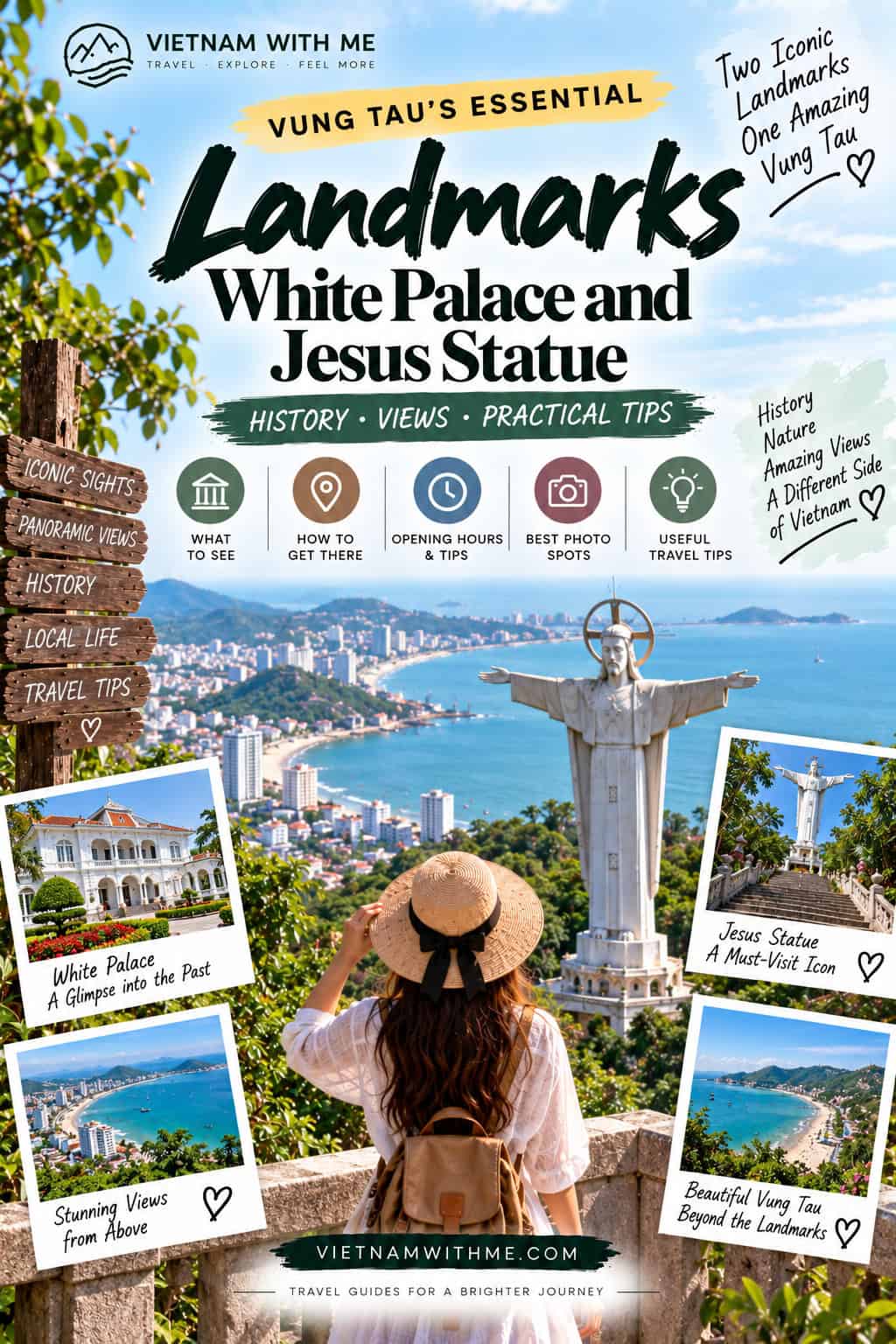
Two of the most recognizable historic landmarks in Vung Tau are the White Palace (Bach Dinh) and the Christ the King statue.
The White Palace is a historic colonial-era villa you can visit without a strenuous climb.
In contrast, the Christ the King statue on Small Mountain offers prime viewpoints but needs a long staircase climb.
If you are planning your first trip to Vung Tau, it is worth understanding the difference before deciding how much time to allocate to each.
Quick Answer: Which Vung Tau Landmarks Are Worth Visiting?
| Landmark | Best for | Physical effort | My verdict |
|---|---|---|---|
| White Palace | History, architecture, easy sightseeing | Low | Worth visiting |
| Christ the King Statue | Views, religious landmark, challenge | High | Worth it if you can climb |
| Vung Tau Lighthouse | Panoramic views and sunset | Moderate | One of the best viewpoints |
| Mũi Nghinh Phong | Coastal scenery and photos | Low to moderate | Easy to combine with the statue |
The important thing is that you do not need to climb every mountain in Vung Tau.
You can also enjoy many of the historic landmarks in Vung Tau by using easier routes.
1. White Palace (Bach Dinh)
Best for: history, architecture and an easy cultural stop.
The White Palace, known locally as Bach Dinh, is one of the most interesting historic landmarks in Vung Tau.
The villa was built at the end of the 19th century during the French colonial period.
It was designed as a European-style residence overlooking the sea.
Today, it provides a very different experience from Vung Tau’s beaches, modern hotels and restaurants.
The building sits on the slopes of Big Mountain above the coastal road, and it is embraced by lush greenery. The terrain provides a vantage point that highlights its position on the hillside and its integration with the landscape for travelers.
Its white exterior, red-tiled roof, and decorative details contribute to its distinctive appearance, making the structure immediately recognizable to visitors and locals alike.
The building also contains historical objects and decorative pieces.
This offers visitors a chance to understand another layer of Vung Tau’s history.
If you are interested in colonial architecture or the history of southern Vietnam, I would definitely put the White Palace on your itinerary.
You can also browse Vung Tau attractions if you want to combine it with other sightseeing stops.
2. Is the White Palace Worth Visiting?
Yes, particularly if you are already exploring the Front Beach and Big Mountain side of Vung Tau.
The White Palace is not a huge museum that requires half a day. That is one of its advantages.
You can visit it as part of a larger sightseeing route.
Spend some time looking at the building and exhibits.
Then enjoy the surroundings and continue to another attraction.
It is also a much better choice than the Christ statue for travelers who cannot comfortably climb hundreds of stairs.
For visitors who want more museums, our Best Museums in Vung Tau guide covers the city’s other major museum experiences.
3. Christ the King Statue in Vung Tau
Best for: panoramic views, religious landmarks and adventurous travelers
The Christ the King statue is probably the most recognizable historic landmark in Vung Tau, and it attracts visitors while reflecting the city’s religious heritage.
The statue stands on Small Mountain. It is approximately 32 meters high, with outstretched arms spanning about 18.4 meters.
It is not simply a statue that you look at from the road.
Visitors can climb the mountain to reach the monument.
When access conditions allow, visitors can continue inside the statue via a narrow staircase toward the shoulders.
The climb is the main thing you need to know before visiting.
4. How Many Steps Are There to the Christ Statue?
Expect roughly 800 steps to reach the base area, plus another 133 steps inside the statue if you want to reach the viewing area in the shoulders.
The exact way the staircase count is described varies between sources, but there is no question about the important part: this is a substantial climb.
If you are reasonably fit, the climb can be part of the experience, but if you have mobility problems, you can skip it. If you are recovering from an injury or do not want to climb many stairs in Vietnam’s heat, there is no need to push yourself.
You can enjoy plenty of other Vung Tau attractions without making this particular climb.
For another panoramic viewpoint that is much easier to access, see our Vung Tau Lighthouse guide.
5. Is the Christ Statue Worth the Climb among historic landmarks in Vung Tau?
For people who can comfortably manage the stairs, yes — and the reward is not only the monument itself. The higher you climb, the more impressive the views become, taking in Vung Tau, the coastline, and the surrounding sea.
The statue also has a completely different atmosphere from a normal tourist attraction because it remains an important religious site.
Visitors should therefore dress appropriately and behave respectfully.
Entry to the statue area is generally free, but conditions and access rules can change, so check locally before making the climb.
If you are looking for other things to do in Vung Tau, there is no reason to make the Christ statue the only major attraction of your day.
6. What If You Cannot Climb to the Christ Statue?
This is where planning makes a big difference.
You can still visit the area around Small Mountain and combine it with attractions that require much less physical effort.
Mũi Nghinh Phong is nearby and offers a very different coastal experience. You can also visit the lighthouse area and then continue along the waterfront.
In other words, you do not have to choose between climbing 800+ stairs or doing nothing.
Build your itinerary around the attractions you can comfortably enjoy.
7. White Palace vs Christ the King Statue
| White Palace | Christ the King Statue | |
|---|---|---|
| Main attraction | Architecture and history | Monument and views |
| Location | Big Mountain | Small Mountain |
| Physical effort | Low | High |
| Best for | History lovers | View seekers |
| Family friendly | Generally easier | Depends on fitness |
| Time needed | About 30–60 minutes | Allow significantly longer |
If you only have time for one and do not want a difficult climb, I would choose the White Palace.
If spectacular views and unusual landmarks are more important to you than comfort, choose the Christ statue.
If you have enough time, visit both.
8. Vung Tau Lighthouse: The Easier Viewpoint
The Vung Tau Lighthouse is another historic landmark that can easily be combined with the Christ statue and Mũi Nghinh Phong.
The lighthouse dates back to the French colonial period and sits on Small Mountain overlooking the city and sea.
Compared with climbing to the Christ statue, reaching the lighthouse is a much more manageable experience for many visitors.
The road leading toward the lighthouse also makes the journey part of the attraction, with increasingly wide views over Vung Tau as you gain elevation.
It is particularly attractive around sunset, although you should allow enough time to return safely after dark.
You can also compare Vung Tau sightseeing experiences if you want to add a guided activity to your trip.
9. Mũi Nghinh Phong and the Historic Landmarks Route
Mũi Nghinh Phong is one of the easiest places to combine with the Christ statue because both are located around Small Mountain.
The cape is more about coastal scenery than history. You get rocky shoreline, sea views and the famous Sky Gate area.
This combination makes sense because you can experience several completely different sides of Vung Tau within a relatively small area:
- Christ the King — religious landmark and mountain viewpoint.
- Vung Tau Lighthouse — historic lighthouse and panoramic views.
- Mũi Nghinh Phong — coastline and natural scenery.
You can move between the areas by walking where practical or use Grab when you want to save time.
For transport inside the city, see our How to Get Around Vung Tau guide.
10. Can You Visit These Landmarks in One Day?
Yes.
In fact, these attractions work particularly well as part of a single sightseeing day.
A practical route could look like this:
- Start at White Palace.
- Continue along the coastal road.
- Visit Mũi Nghinh Phong.
- Decide whether you want to climb to the Christ the King statue.
- Continue toward the Vung Tau Lighthouse.
- Return toward the waterfront.
- Finish with sunset, dinner or a rooftop bar.
If you are not climbing to the Christ statue, you will have significantly more energy for the rest of the day.
If you want a complete one-day route, use our Vung Tau 1-Day Itinerary.
11. How Much Time Do You Need?
You do not need an entire day for the White Palace alone.
The Christ statue is different because the climb itself takes time, especially if you stop frequently for water, rest and photographs.
For a relaxed day covering several landmarks, I would allow at least half a day for this part of Vung Tau.
If you want to include museums, beaches, a long lunch and sunset, a full day is much more comfortable.
For a two-day visit, these landmarks fit very easily into a broader itinerary. See our Vung Tau 2-Day Itinerary.
12. Which Landmark Is Best for Families?
For families, the White Palace is generally the easier choice.
The Christ statue can be impressive for children, but the staircase climb may be difficult, particularly in hot weather.
If you are traveling with young children, older relatives or anyone with limited mobility, there is no reason to make the statue the centerpiece of your itinerary.
Vung Tau has plenty of alternatives, including the beach, museums, the promenade and Hồ Mây Park.
You can also compare family-friendly hotels in Vung Tau if you are staying overnight.
13. Historic Vung Tau Beyond These Two Landmarks
The White Palace and Christ statue are the city’s most recognizable landmarks, but they are only part of Vung Tau’s history.
The city’s location made it strategically important during the colonial period, and its mountains and coastline contain a mixture of religious, military and architectural sites.
The Worldwide Arms Museum provides a completely different look at the city’s history through its collection of weapons, uniforms and military objects.
There are also numerous temples and pagodas scattered through the city, some of which can be combined into a single walking route.
Our Vung Tau Promenade guide is useful if you want to combine sightseeing with a relaxed walk along the coast.
14. Where Should You Stay to See Vung Tau’s Landmarks?
If sightseeing is your priority, staying somewhere between the main beaches and the central part of the city is convenient.
Back Beach is popular with visitors who want easy access to the sea and a large selection of accommodation, while Front Beach is useful for waterfront walks and access to several central attractions.
Before booking, compare Vung Tau hotels by location rather than looking only at the room price.
Our Where to Stay in Vung Tau guide explains the differences between the main areas.
15. My Recommendation
If you are physically able and interested in unusual landmarks, the Christ statue is worth seeing at least once.
But I would not tell every traveler that they have to climb it.
The White Palace is a much easier cultural attraction, the lighthouse offers another excellent viewpoint, and Mũi Nghinh Phong gives you dramatic coastal scenery without requiring the same staircase challenge.
The best approach is to treat these places as a group of complementary landmarks rather than a checklist where you have to conquer every staircase.
And if you are visiting Vung Tau for only one day, choose the places that match your energy level and interests. You will have a much better trip that way.
Frequently Asked Questions
How many steps are there to the Christ statue in Vung Tau?
There are roughly 800 steps to reach the statue area, followed by another 133 steps inside the statue if you want to reach the viewing area near the shoulders.
Is the Christ statue in Vung Tau free?
The statue is generally free to visit, although access conditions and rules can change. Visitors should also follow the site’s religious dress and behavior requirements.
Is the White Palace in Vung Tau worth visiting?
Yes, especially if you are interested in history and architecture. It is also one of the easier historic attractions to include in a Vung Tau sightseeing itinerary.
Can I visit the White Palace and Christ statue on the same day?
Yes. They can be combined with the Vung Tau Lighthouse and Mũi Nghinh Phong to create a full sightseeing day.
What if I cannot climb to the Christ statue?
You can still enjoy the surrounding Small Mountain area and visit Mũi Nghinh Phong and the lighthouse. Vung Tau also has beaches, museums, temples and other attractions that require much less physical effort.
How long should I spend visiting Vung Tau’s historic landmarks?
Half a day is enough for a focused route, while a full day gives you time to combine the landmarks with museums, beaches, lunch and sunset.
What are the best historic attractions in Vung Tau?
The White Palace, Christ the King statue and Vung Tau Lighthouse are among the city’s most recognizable historic landmarks. The Worldwide Arms Museum is another excellent choice for visitors interested in history.
More from our travel guide network
Build your Vietnam route — free.