Ha Giang is not really a destination you visit by collecting attractions.
The best Ha Giang tours and experiences offer a more cohesive way to explore.
You come here for the road.
The mountains change every few kilometers, small villages appear between enormous limestone cliffs, and a normal transfer from one town to another can turn into the most memorable part of the day.
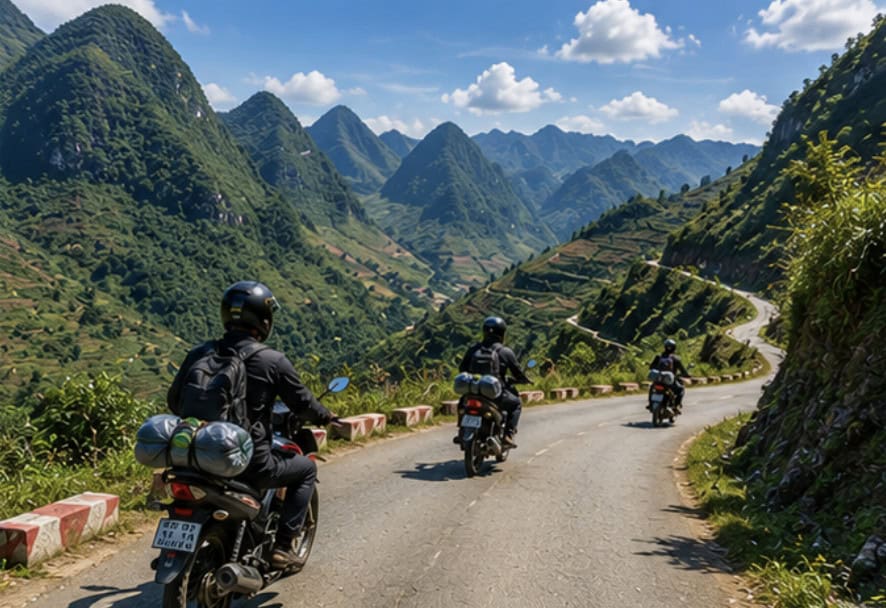
That is why the best Ha Giang tours are usually built around the Ha Giang Loop, with stops for viewpoints, villages, mountain passes, rivers and local experiences along the way.
What Are the Best Ha Giang Tours and Experiences?
Best Ha Giang Tours & Experiences
For first-time visitors to Ha Giang, these are the experiences worth considering:
- Ha Giang Loop Motorbike Tour
- Ha Giang Easy Rider Tour
- Ma Pi Leng Pass Tour
- Nho Que River Boat Trip
- Dong Van Karst Plateau Tour
- Ha Giang Village & Homestay Experience
- Ha Giang Mountain Trekking Tour
- Private Ha Giang Loop Tour
If you are still deciding whether the region fits your trip, start with our Ha Giang for First-Time Visitors guide. It covers the practical side before you start choosing individual experiences.
1. Ride the Ha Giang Loop
The Ha Giang Loop is the experience that defines the region.
The classic route runs through Quan Ba, Yen Minh, Dong Van and Meo Vac before returning toward Ha Giang, although operators use slightly different itineraries.
You can do the loop in three days, but four days is much more comfortable if you actually want to stop for viewpoints, villages and photographs instead of spending the entire trip on the road.
The official Vietnam Tourism site describes the loop as one of the region’s defining road-trip experiences, with the route passing through the Dong Van Karst Plateau and some of northern Vietnam’s most dramatic mountain scenery.
The important thing is not to rush.
On Ha Giang, a ten-minute photo stop can easily become thirty minutes because the next bend looks even better.
2. Choose an Easy Rider Instead of Riding Yourself
If you are not an experienced motorbike rider, an Ha Giang Easy Rider Tour is the option I would seriously consider.
The roads are mountainous, winding and sometimes narrow. The scenery is spectacular, but the riding itself requires concentration.
With an Easy Rider, you sit on the back while a local driver handles the bike.
That changes the experience considerably.
You can look around, take photographs and actually watch the landscape instead of constantly thinking about the next corner.
Vietnam Tourism also recommends using a local driver rather than attempting these mountain roads alone, particularly for travelers who are not confident with the terrain.
3. Drive Across Ma Pi Leng Pass
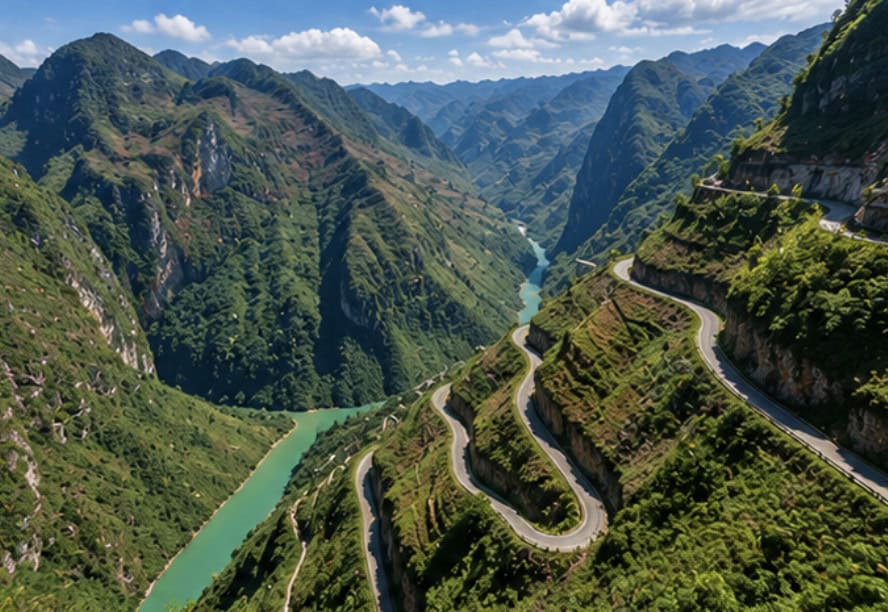
Ma Pi Leng Pass Tours are the part of the loop that most people remember.
The road climbs above the Nho Que River and cuts through enormous limestone mountains between Dong Van and Meo Vac.
There are several viewpoints along the route, but the road itself is the main attraction.
You will probably stop repeatedly.
That is normal.
Vietnam Tourism describes Ma Pi Leng as the jewel of Ha Giang, and it is easy to understand why once the valley opens below you.
If the weather is clear, the scale is almost difficult to process.
4. Walk the Ma Pi Leng Sky Path
The Ma Pi Leng Sky Path gives you a different perspective from simply riding the pass.
Instead of looking at the mountains through a helmet visor, you can walk along the mountainside and take in the landscape at a much slower pace.
The route is not something I would treat as a major separate excursion.
It works best as part of your Ma Pi Leng day, particularly if you want some time away from the motorbike.
Wear proper footwear and be sensible around exposed edges.
5. Take a Boat on the Nho Que River
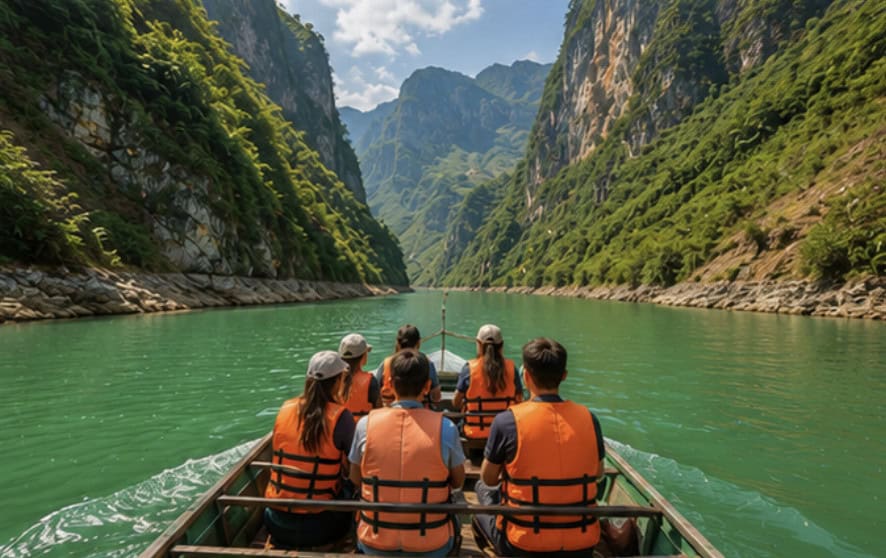
Nho Que River Boat Trips are one of the best ways to see the mountains from below.
The river runs through Tu San Canyon beneath the Ma Pi Leng area, with towering cliffs rising on both sides.
After several hours of mountain roads, getting onto the water feels completely different.
The road becomes a thin line somewhere above you, while the canyon walls dominate the view.
Allow some flexibility in your itinerary because river conditions and access can vary.
The official Vietnam Tourism guide specifically highlights the Nho Que River and Tu San Canyon as major experiences along the Ha Giang route.
6. Explore Dong Van Old Quarter
Dong Van Old Quarter Tours are a good way to slow down after a full day on the road.
Dong Van is one of the main overnight stops on the classic loop.
The old quarter has a distinctly different atmosphere from Ha Giang City, with traditional buildings, small cafes and a compact central area that is easy to explore on foot.
If you arrive in the afternoon, do not immediately disappear into your hotel.
Walk around town, have coffee and stay for dinner.
The whole point of traveling through Ha Giang is experiencing places between the famous viewpoints as well.
7. Visit Dong Van Sunday Market
If your route allows it, Dong Van Sunday Market is one of the more interesting cultural experiences in the region.
People from surrounding communities come into town to trade food, livestock, clothing and everyday goods.
It is not simply a performance organized for tourists.
That is precisely why it is worth seeing.
Go early, keep a respectful distance when photographing people and remember that this is a working market.
8. Visit the Vuong Family’s Residence
Vuong Family’s Residence, also known as the Hmong King’s Palace, sits near Sa Phin between Yen Minh and Dong Van.
The complex is an unusual architectural mixture influenced by Hmong, Chinese and French traditions.
It is one of the few stops on the loop where the focus shifts away from scenery and toward history.
If you are interested in how the region was governed and how wealthy local families lived, this is much more worthwhile than simply stopping for another mountain photograph.
9. Visit Lung Cu Flag Tower
Lung Cu Flag Tower Tour takes you toward one of the northernmost points commonly visited by travelers in Vietnam.
The tower stands high above the surrounding landscape, close to the Chinese border.
The journey there is part of the attraction.
You pass through increasingly remote mountain scenery before reaching the viewpoint.
It is worth adding if you have enough time in the Dong Van area, but do not force it into an already overloaded three-day loop.
10. Stop at Quan Ba Heaven’s Gate
Quan Ba Heaven’s Gate is one of the first major viewpoints on the northern section of the loop.
For many travelers, this is the moment when Ha Giang starts to feel completely different from the rest of Vietnam.
The road climbs above the valley and opens onto a huge landscape of limestone peaks and farmland.
The viewpoint is particularly useful early in the trip because it gives you an immediate sense of what is ahead.
11. See the Quan Ba Twin Mountains
Quan Ba Twin Mountains Viewpoint is another natural stop that works well on the first day of the loop.
The two rounded hills sit in the valley below the road and are surrounded by fields and villages.
Do not expect to spend hours here.
It is primarily a viewpoint and photography stop, but it is an excellent introduction to the landscape of Ha Giang.
12. Stay in a Local Homestay
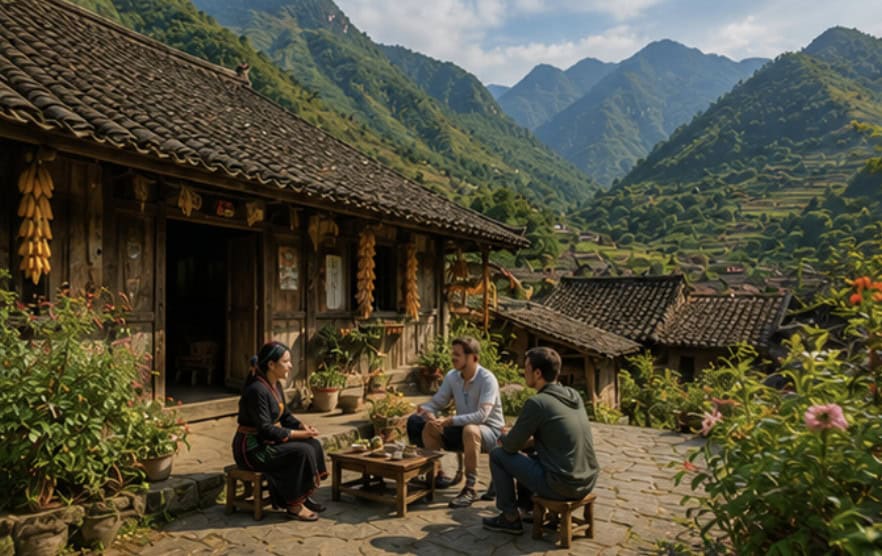
A Ha Giang Village Homestay Experience is one of the easiest ways to make the trip feel less like a standard sightseeing tour.
Instead of staying in a conventional hotel every night, spend at least one evening in a family-run homestay.
You may eat dinner with the hosts, sleep in a traditional-style house and wake up surrounded by mountains rather than traffic.
Du Gia is particularly well suited to this type of stay.
The experience is not about luxury.
It is about location, hospitality and seeing how people actually live in the valleys.
13. Spend a Night in Du Gia
Du Gia Village Tours are a good choice if you want to finish the loop at a slower pace.
Du Gia sits in a green valley with rice fields, small roads and traditional houses.
Compared with the dramatic mountain passes around Dong Van and Meo Vac, the landscape here feels softer.
That contrast is exactly what makes the stop worthwhile.
Stay overnight if possible rather than passing through for thirty minutes.
14. Visit Du Gia Waterfall
Du Gia Waterfall is an easy addition when you are staying in the area.
The waterfall is surrounded by green mountain scenery and is particularly appealing during warmer weather.
Bring swimwear if local conditions make swimming appropriate, but do not assume the water is always safe after heavy rain.
This is another reason to leave some flexibility in a Ha Giang itinerary.
15. Trek Through the Dong Van Karst Plateau
Dong Van Karst Plateau Trekking Tours are worth considering if you prefer walking to spending every hour on a motorbike.
The geopark is one of the defining landscapes of northern Vietnam, with dramatic limestone formations, valleys and traditional communities.
Vietnam Tourism identifies the Dong Van Karst Plateau Geopark as a UNESCO Global Geopark and highlights hiking as one of the best ways to explore it.
A local guide can also add context that you simply will not get from riding through the landscape.
16. Explore Local Villages
Ha Giang Village Tours are a good choice when you want to understand the cultural side of the region.
Ha Giang is home to communities including Hmong, Tay and Dao people, among others.
The houses, clothing, farming methods and village layouts can change noticeably from one valley to another.
Do not treat villages as photo backdrops.
Walk slowly, ask before photographing people, and use a local guide when possible.
17. Try a Ha Giang Food Experience
Ha Giang Local Food Tours are an underrated part of the loop.
The food is different from what you will find in Hanoi, Da Nang or Ho Chi Minh City because it reflects the mountain environment and local ethnic traditions.
Look for dishes such as thang co, buckwheat-based foods, corn wine and simple mountain-style meals served at homestays.
You do not have to love every dish.
The point is to try something connected to the place rather than eating the same Western meal every evening.
18. Visit Ha Giang’s Buckwheat Flower Fields
Ha Giang Buckwheat Flower Tours are especially interesting during the flowering season.
Buckwheat is closely associated with the highlands and has become one of Ha Giang’s most recognizable seasonal landscapes.
The exact appearance of the fields depends on weather and agricultural cycles, so do not plan an entire trip around seeing one specific field.
Instead, treat the flowers as one element of a broader mountain itinerary.
19. Take a Private Ha Giang Loop Tour
If you do not want to join a large group, a Private Ha Giang Loop Tour gives you considerably more control over the pace.
You can stop when the weather changes, spend longer at a viewpoint or skip a crowded attraction.
This is particularly useful for photographers and couples.
It is also worth considering if you have four or five days available and do not want to spend the entire trip following a fixed schedule.
20. Take a Car Tour Instead of a Motorbike
Not everyone needs to experience Ha Giang from a motorbike.
A Ha Giang Loop Car Tour with Driver can make sense for families, older travelers or anyone who is uncomfortable on mountain roads.
You will obviously lose some of the feeling of riding directly through the landscape, but you still experience the passes, villages, viewpoints and river valleys.
For travelers who prioritize comfort or safety, that can be a very reasonable trade-off.
Which Ha Giang Experience Is Best for You?
| Experience | Best For |
|---|---|
| Ha Giang Loop | First-time visitors and adventure travellers |
| Easy Rider | Travellers who do not want to ride themselves |
| Ma Pi Leng Pass | Mountain scenery and photography |
| Nho Que River | Scenery from the water |
| Dong Van | History, food and overnight stays |
| Local homestay | Culture and local life |
| Du Gia | Quiet valleys and nature |
| Dong Van Geopark trekking | Hikers |
| Lung Cu | Landmarks and northern Vietnam |
| Private tour | Couples, families and photographers |
Best Ha Giang Tours for First-Time Visitors
If you have never been to Ha Giang, I would not try to build the trip around individual attractions.
Book a 3- or 4-day Ha Giang Loop and let the route connect the major experiences for you.
The most important combination is Quan Ba, Dong Van, Ma Pi Leng, Meo Vac and Du Gia.
If possible, choose a route that includes at least one proper homestay rather than sleeping in hotels every night.
Best Ha Giang Tours for Couples
Couples have a strong reason to consider a private Ha Giang Loop tour, since the region rewards flexibility: if the light is beautiful, stop; if a village looks interesting, stop; if you are tired, slow down.
A private itinerary makes those decisions much easier than a large group tour.
Best Ha Giang Tours for Families
Families should think carefully about the transport format.
If children are not comfortable spending hours on a motorbike, choose a private car tour with a local driver.
You can still visit Ma Pi Leng, Dong Van, the villages and Nho Que River without putting everyone on a motorcycle.
The shorter driving sections and flexibility of a private itinerary are particularly useful with younger children.
Best Ha Giang Experiences for Adventure Travelers
For experienced riders, the Ha Giang Loop Motorbike Tour is the obvious starting point.
But adventure does not mean riding as fast as possible.
The best parts of the loop are the sections where you slow down enough to actually see what is around you.
Add a trek, a river trip or a village homestay if you want the experience to be more than just a long motorcycle ride.
Best Ha Giang Experiences for Photography
Ha Giang is almost unfairly photogenic.
The trick is to photograph different aspects of the region rather than taking twenty versions of the same mountain road.
Use Ma Pi Leng for dramatic scale, the Nho Que River for depth and color, and local villages for people, houses and everyday life — and keep some time for the road itself.
The best photograph may be the one you take from an unplanned stop between two official viewpoints.
How Many Days Do You Need for Ha Giang Tours?
Three days is possible, but the schedule is relatively tight.
Four days is the sweet spot for most first-time visitors.
Five days or more gives you time to slow down, add trekking and spend longer in villages or homestays.
The classic loop is generally completed in three or four days, but adding another day can make the experience much less rushed.
For the practical side of planning the trip, our Ha Giang for First-Time Visitors guide is the better starting point.
Can You Do the Ha Giang Loop Without a Tour?
Yes, but this is where an honest assessment of your riding ability matters.
The roads are mountainous and conditions can change quickly.
If you are an experienced rider with the appropriate legal documentation and genuine confidence on mountain roads, independent travel is possible.
If you are not, an Easy Rider or private car is the more sensible option.
The point of Ha Giang is not proving that you can ride it yourself.
The point is seeing the region safely.
Is the Ha Giang Loop Safe?
The route is not technically a normal sightseeing road trip.
You are dealing with mountain passes, sharp bends, elevation changes, weather and traffic from other motorcycles.
Take the road seriously.
Do not ride after drinking, do not rush corners and do not assume that a dry road in the morning will stay dry all day.
For travelers without strong motorcycle experience, a local driver is the safer choice.
What Should You Bring on a Ha Giang Tour?
- Light layers.
- A waterproof jacket.
- Comfortable closed shoes.
- Sun protection.
- Gloves if riding.
- Small backpack rather than a large suitcase.
- Power bank.
- Basic personal medication.
- Cash for smaller villages and local stops.
If Ha Giang is part of a longer Vietnam trip, our Vietnam Packing List covers the wider essentials.
A Simple Four-Day Ha Giang Loop
Day 1 — Ha Giang to Yen Minh
Leave Ha Giang early and head toward Quan Ba.
Stop at Heaven’s Gate and the Twin Mountains before continuing through the mountain landscape toward Yen Minh.
This first day is about getting used to the road.
Day 2 — Yen Minh to Dong Van
Continue toward Dong Van through the karst landscape.
Depending on your pace, add the Vuong Family’s Residence and Lung Cu.
Stay in Dong Van and explore the old quarter in the evening.
Day 3 — Dong Van to Meo Vac and Du Gia
This is the dramatic day.
Cross Ma Pi Leng, stop at the viewpoints and descend toward the Nho Que River if your itinerary includes the boat trip.
Continue toward Du Gia for the night.
Day 4 — Du Gia to Ha Giang
Take the slower roads back toward Ha Giang.
Leave enough time for photographs, villages and roadside stops rather than treating the final day as a race to the finish.
Final Thoughts
Ha Giang is one of those rare places where the journey genuinely matters more than the destination.
You will remember Ma Pi Leng.
You will remember the Nho Que River.
You will remember the mountains around Dong Van.
But you may also remember the tiny roadside cafe where you stopped because it started raining, or the family dinner at a homestay, or a completely unplanned viewpoint that was not even on your itinerary.
That is why I would not over-plan Ha Giang.
Choose a good Ha Giang Loop Tour, make sure the transport matches your riding experience, leave enough time for the mountains and let the road do the rest.
For the practical details before you book anything, continue with our Ha Giang for First-Time Visitors guide.
Frequently Asked Questions
What is the best Ha Giang tour?
For first-time visitors, a three- or four-day Ha Giang Loop is the best overall introduction to the region.
Should I ride the Ha Giang Loop myself?
Only if you have genuine motorcycle experience and the required legal documentation. Otherwise, an Easy Rider or private car tour is a better option.
How many days do you need for the Ha Giang Loop?
Four days is ideal for most travelers. Three days is possible, while five days or more gives you more time for villages, trekking and homestays.
Is Ma Pi Leng Pass worth visiting?
Yes. It is one of the defining landscapes of Ha Giang and one of the most spectacular sections of the loop.
Can you take a boat on the Nho Que River?
Yes. Boat trips can be included in Ha Giang Loop itineraries, although access and operating conditions can vary.
Is Ha Giang good for families?
Yes, but families should carefully choose their transport. A private car with a local driver can be much more comfortable than spending several days on motorbikes.
Where should I stay during the Ha Giang Loop?
Dong Van and Du Gia are two particularly useful overnight stops. Local homestays are worth considering if you want more cultural interaction.
What is the best month for the Ha Giang Loop?
Different seasons offer different scenery. Spring brings flowers, summer brings greener landscapes, autumn is associated with rice fields, and later in the year buckwheat flowers can appear.
Can I do Ha Giang without a tour?
Yes, but the decision should depend on your riding experience, legal requirements and comfort with mountain roads. For many travelers, a local driver makes the trip considerably easier.
More from our travel guide network
Build your Vietnam route — free.