I will be honest: I rarely go to museums. They are usually dusty, boring, and make me want to escape outside as quickly as possible. The Institute of Oceanography Museum in Nha Trang is a completely different story.
This is a place I have returned to several times, and each visit reveals something new. Now I’ve brought along friends with children and watched their faces light up in front of the giant whale skeleton.
It is located in the south of the city at 1 Cau Da Street.
It is literally a couple of minutes from the pier where boats depart for VinWonders and Hon Tam Island.
If you are planning a trip to the islands, the museum fits perfectly into your route.
Visiting the museum in the morning is part of it.
Catching an afternoon boat to Hon Tam is also part of my family itineraries.
If you’re still deciding when to fly in, I usually check flight deals to Cam Ranh first.
The airport is barely an hour away.
You can land, drop your bags, and be standing under a 26‑metre whale skeleton by lunchtime.
🏛️ Not Just a Museum, But a Historic Scientific Institute
The first thing to understand is that this is not just an entertainment aquarium. The museum sits on the grounds of the Institute of Oceanography, the largest marine research center in Vietnam and all of Southeast Asia. It was founded by the French back in 1922 under the name «Indochinese Institute of Oceanography and Fisheries.»
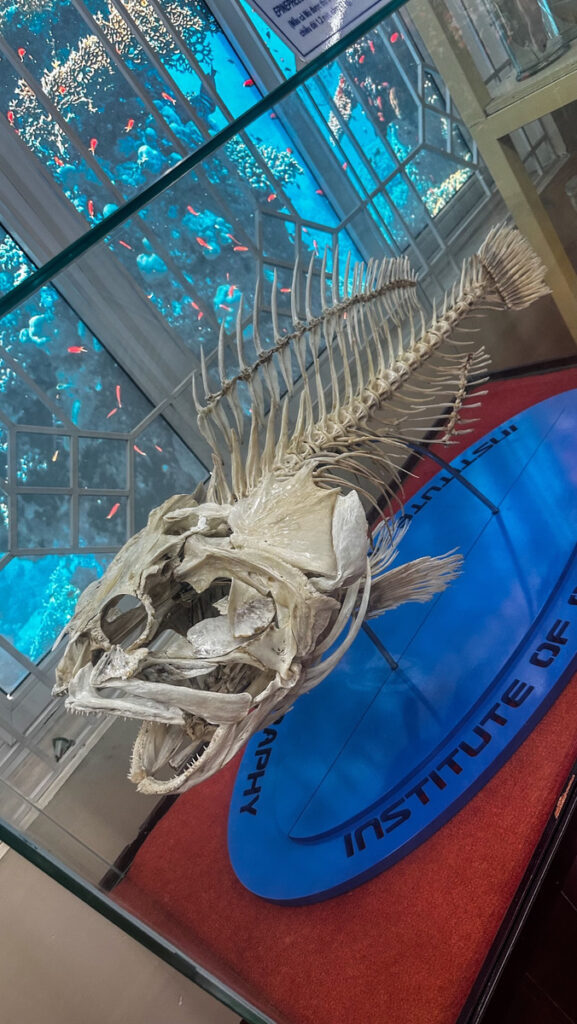
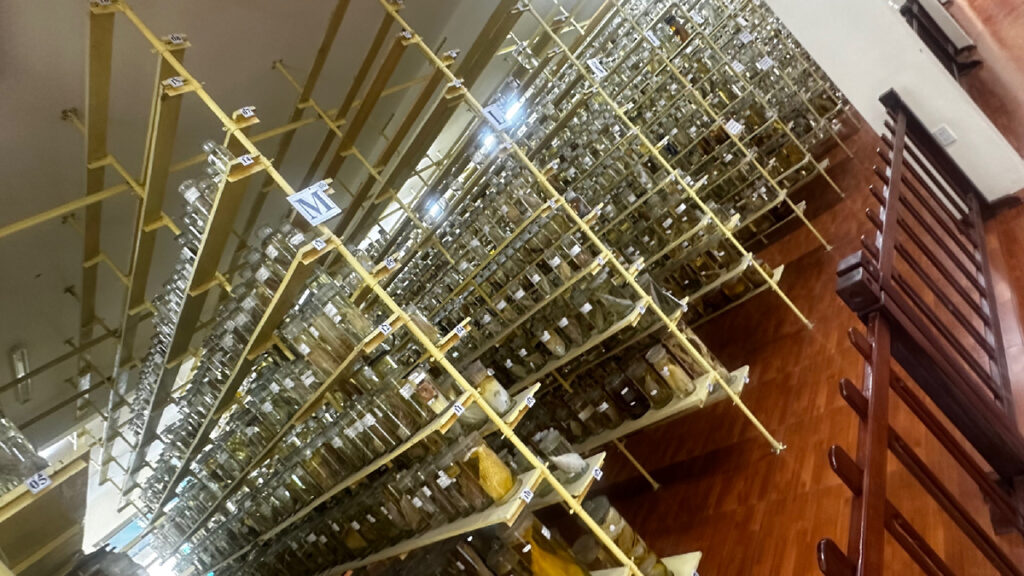
It started as a single room for storing specimens. Today, it houses a gigantic collection: over 20,000 exhibits representing more than 4,000 species of marine flora and fauna. And the collection has been growing for nearly 100 years. Walking through the rooms feels like stepping into a Victorian explorer’s cabinet of curiosities, except the cabinets are real and the fish inside them once swam in the South China Sea.
🐋 The Main «Stars»: A Giant Whale and an Extinct Sea Cow
Two exhibits alone make this museum worth the trip.
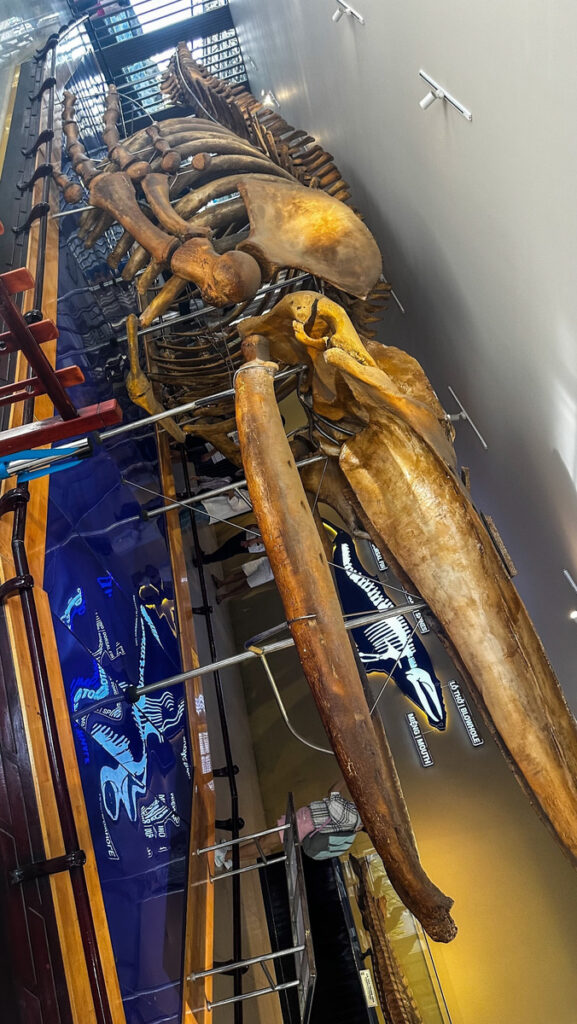
The first is an enormous whale skeleton. It measures 26 meters long and stands about 3 meters high. To put that in perspective, that is the length of two buses parked end to end. It was discovered in northern Vietnam, several kilometers from the sea – apparently carried inland by a storm surge and buried in sediment for decades. Standing next to it, you feel absolutely tiny. Children invariably stop in their tracks, mouths open, trying to comprehend how something so large once swam through the ocean.
The second exhibit is a preserved Steller’s sea cow. This species was completely driven to extinction by humans back in the 18th century, about 250 years ago. Seeing one with your own eyes is a rare chance to touch something that no longer exists on our planet. It’s a quiet, slightly haunting reminder of why marine conservation matters, and it sparks surprisingly deep conversations with older kids.
🐠 What Else to See: Aquariums and a «Miniature Ocean»
The museum has several large sections. The most spectacular is the aquarium system, often called a «miniature ocean.» More than 300 species of marine life swim here: sharks, rays, sea turtles, moray eels, clownfish living symbiotically with anemones, bright corals, starfish, urchins, crabs, and shrimp. The tanks are well‑maintained and clearly labeled in both Vietnamese and English, so you actually learn something while the kids press their noses against the glass.
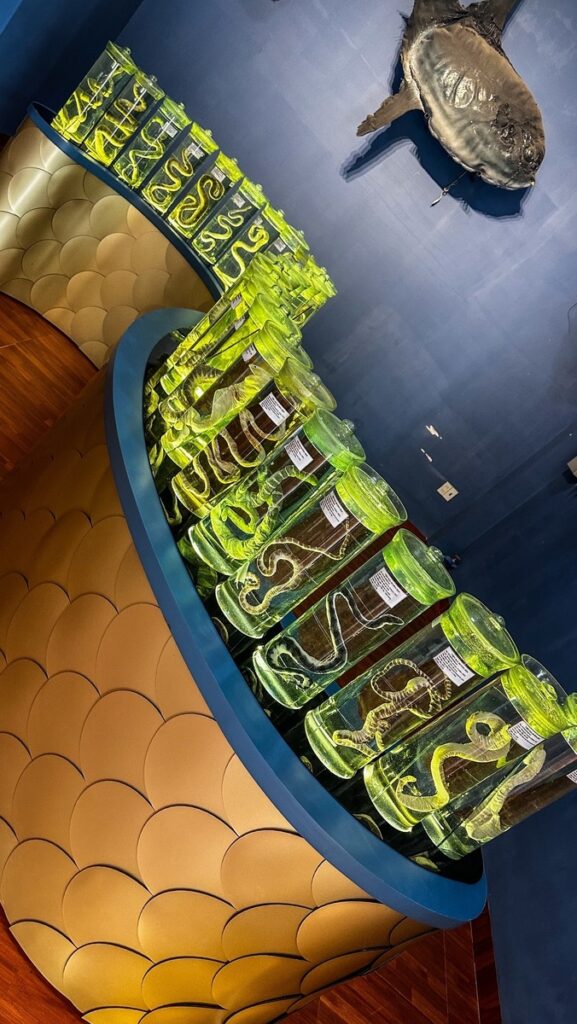
In a separate hall of nearly 200 square meters, large taxidermy specimens and skeletons of rare marine animals are on display. And in the building with preserved wet specimens, you can view over 60,000 samples — from tiny fish to surprisingly large creatures floating in jars of formalin. It’s slightly eerie and absolutely fascinating.
🌊 A New Feature: Journey to a Depth of 6000 Meters
Recently, the museum opened a new exhibition zone called «Mysterious Ocean.» It is built on a unique concept: you descend as if from the ocean surface down to a depth of 6000 meters. The lighting shifts from bright blue to pitch black, the temperature drops slightly, and the displays introduce the creatures that survive under pressure that would crush a human instantly. Kids love the drama; adults love the science.
The space is divided into three zones:
- The illuminated floor — the «tropical forest» of the ocean with its colorful inhabitants.
- Twilight and eternal darkness floor — here you can witness the phenomenon of «marine snow,» the gentle drift of organic particles that sustains life in the deep.
- The endless abyss floor — a realm of perpetual darkness, cold, and extreme pressure. The anglerfish models here are genuinely creepy.
🐢 A «Rescue Station» for Marine Life
Few people know this, but the museum also functions as a rescue center. Rare marine animals — turtles, seals — that have gotten lost in the wild or caught in fishing nets are brought here. They are cared for, treated, their behavior is studied, and whenever possible, they are returned to their natural habitat. If you’re lucky, you might see a recovering sea turtle gliding in a quarantine tank near the back of the complex. It’s a small, hopeful corner of the museum that most visitors walk straight past.
💡 Practical Tips: How Not to Ruin Your Visit
- ❌ DO NOT come as part of a tour group. You will be rushed through, see almost nothing properly, and miss the atmosphere entirely. It is much better to come independently and explore at your own pace.
- ✅ DO arrive at opening time — 6:00 AM. The museum opens very early (and stays open until 6:00 PM daily, no days off). Mornings are almost empty, so you can enjoy everything in peace. The early light through the old windows also makes the main hall look beautiful.
- ❌ DO NOT rush. The grounds are large, with several buildings. Many visitors race through in an hour, and that is a mistake. Plan for 2–3 hours to take it all in thoughtfully.
- ✅ DO wear comfortable shoes. You need to walk between buildings outdoors, so thin‑soled flip-flops are not the best choice. The paths are shaded by old trees, but they’re uneven in places.
Mobile data around the southern part of the city can be spotty, and you’ll want Maps working if you’re riding a motorbike. I activate an eSIM for Vietnam before I even leave home; it spares me the hunt for a SIM card and keeps the connection alive right from the museum courtyard. If you prefer the freedom to drive yourself, you can pick up a rental car at the airport and reach the museum in under an hour.
🚗 How to Get There
- By taxi: From the city center, the ride costs around 40,000 – 60,000 VND (about $1.60 – $2.40 USD).
- By bus №4: The most budget‑friendly option. The fare is only 4,000 VND (about $0.15 USD), and the bus runs from the northern parts of the city directly to Cau Da Port.
- By motorbike: If you have rented a bike, simply head south along the promenade from the center; it takes 10–15 minutes.
💰 Cost
Entrance tickets cost:
- 40,000 VND for adults (about $1.60 USD)
- 20,000 VND for students
- 10,000 VND for schoolchildren
- Free for children under 6
Tickets can be bought right on the spot; no advance booking is needed.
🐚 More Nha Trang Experiences for Families
The Nha Trang Oceanography Museum is a great value, like the Institute of Oceanography Museum, delivering impressions for pocket change. I recommend it for families with kids (they will love it) and for anyone on a rainy day. If the weather turns, this place is a lifesaver – fully sheltered, air-conditioned in the wing, and entertaining for hours.
I have returned here several times myself and always discovered something new. So if you are in Nha Trang, do not pass it by! And if you are building your full city plan, this spot fits perfectly into my 9‑day Nha Trang itinerary — it is a great morning activity before catching a boat to the islands. For more family‑friendly ideas, the Enchanted Forest with Mini Zoo near the airport is another wonderful option that kids absolutely adore. And before any trip with little ones, I always make sure I’m covered — a good travel insurance policy gives me peace of mind, especially with curious kids who touch everything.
Frequently Asked Questions
Where is the museum located?
At 1 Cau Da Street in Nha Trang, a couple of minutes from the pier for boats to VinWonders and Hon Tam Island.
How big is the whale skeleton?
It measures 26 meters long and stands about 3 meters high.
When was the museum founded?
It was founded by the French in 1922 as the “Indochinese Institute of Oceanography and Fisheries.”
What’s the collection size?
Over 20,000 exhibits representing more than 4,000 species of marine flora and fauna.
What’s the Steller’s sea cow exhibit?
A preserved specimen of a species driven to extinction by humans in the 18th century, about 250 years ago.
Disclosure: This article contains affiliate links. If you book through them, I may earn a small commission at no extra cost to you. I only recommend experiences I have personally tested and loved.
Planning a wider Southeast Asia trip?
Cambodia With Me — practical Cambodia travel guides
Siam With Me — Thailand travel guides
Indonesia With Me — Indonesia travel guides
Singapore With Me — Singapore travel guides
Build your Vietnam route — free.