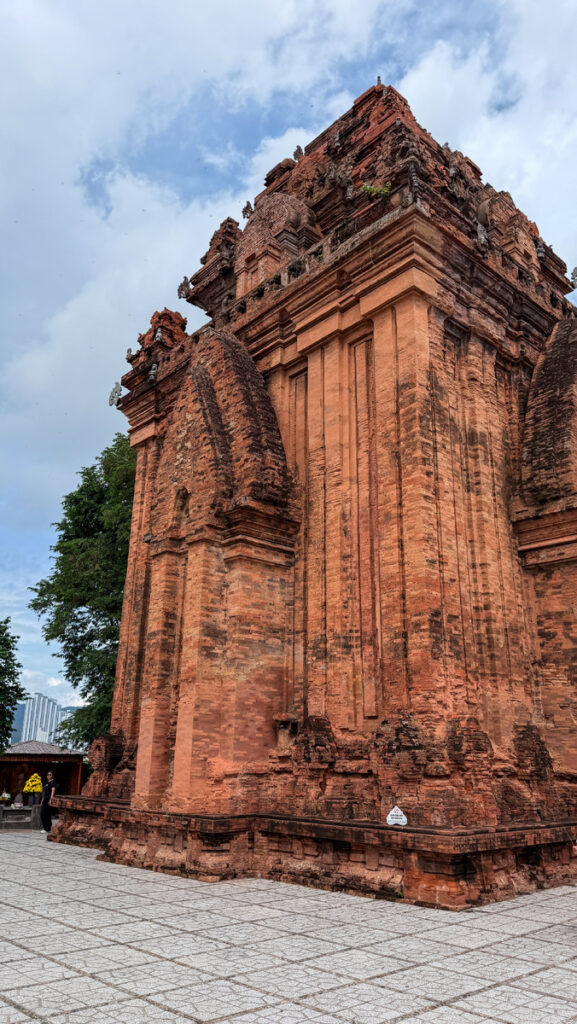
Do you know what I love most about Nha Trang? It is not just a beach resort. Drive just a couple of kilometers from the promenade, and you are transported to a completely different era. Po Nagar Towers is exactly that kind of place.
These are not simply ancient ruins.
They form an active temple complex where people still come to pray.
The incense drifts across the stone terraces, and the hum of the city feels a thousand miles away.
It is arguably one of the most atmospheric spots in the entire city, yet plenty of visitors skip it because they don’t know what they’re missing.
🗿 A Bit of History to Set the Scene
To truly appreciate where you are standing, imagine a time between the 8th and 13th centuries when the powerful Kingdom of Champa flourished on these lands. Po Nagar Towers served as one of its main religious centers, a place dedicated to the mother goddess Po Nagar, protector of the land and its people. Built on Cu Lao Hill by the Cai River, this complex has been a pilgrimage site for centuries and, remarkably, remains one to this day. The bricks used to construct the towers were baked to an astonishing hardness, and their secret mortar – still not fully understood – has kept them standing through monsoons, wars, and the relentless tropical sun.
When you touch the weathered red brick with your palm, you’re touching something that has witnessed a millennium of prayers. Very few attractions in Vietnam give you that physical connection to history, and that’s exactly why this place deserves a spot on your itinerary. If you’re still piecing together your Nha Trang plan, my 9‑day Nha Trang itinerary includes this temple on Day 3, alongside the craft village and a whimsical forest. And if you haven’t locked in your flights yet, I usually start by scanning flight deals to Cam Ranh – the airport is less than an hour’s drive from the towers, so you can land in the morning and be standing among ancient ruins before noon.
📸 What Awaits You: From the Base to the Summit
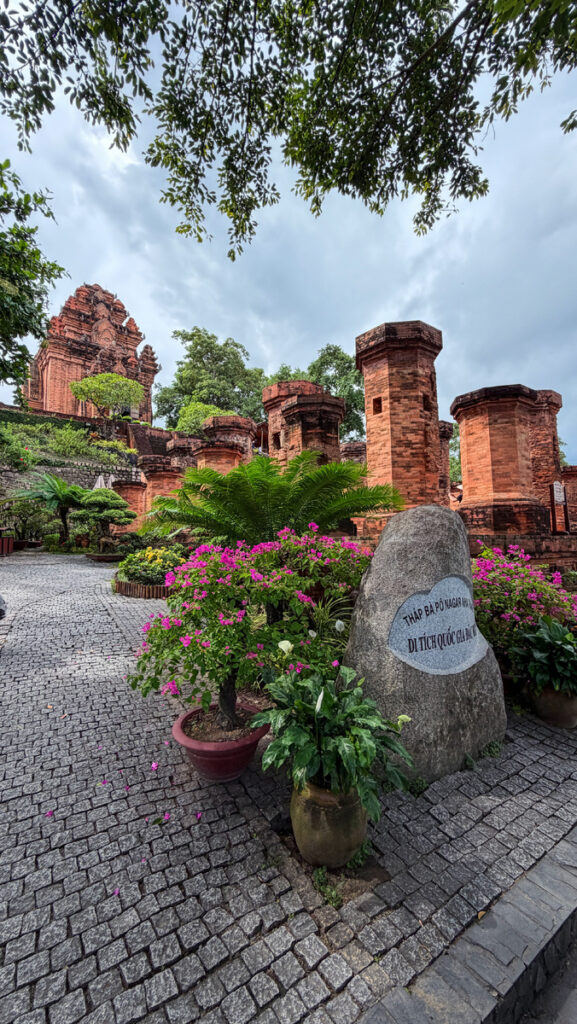
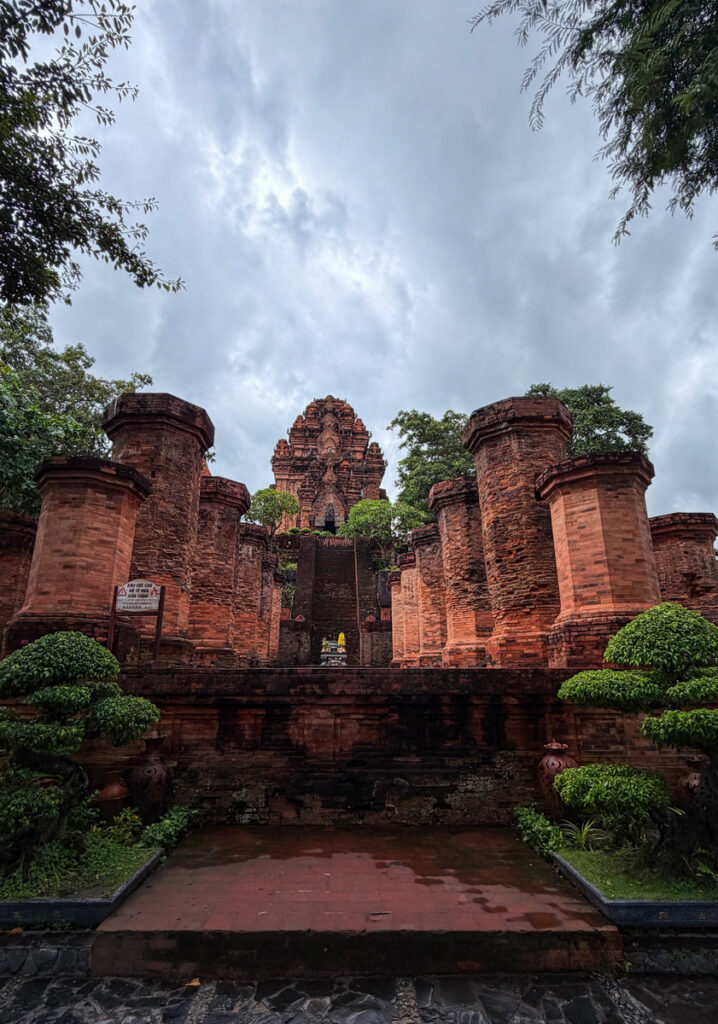
Your visit begins at the foot of the hill. You will immediately notice rows of ancient brick columns — this is the Mandapa, a place where pilgrims have rested and prepared offerings for centuries before ascending to the temples. Take a moment here; the stone benches in the shade are a perfect spot to watch local families arrive with trays of flowers and fruit.
After climbing the staircase, you will find yourself in front of the main treasure: four surviving towers built of red brick without any modern mortar. The tallest among them, the North Tower (Thap Chinh), rises to 23 meters and is dedicated to the goddess Po Nagar. Inside this tower lies the main altar — a polished stone lingam that represents the goddess’s creative power — and entry is only permitted for those dressed appropriately. A small sign at the entrance in Vietnamese asks visitors to remove their shoes and keep their voices low; follow it, and you’ll be rewarded with a sudden, enveloping silence. The other towers are dedicated to different deities, but even just wandering around them is a pleasure, especially in the early morning when the light catches the carved inscriptions on the doorframes.
The viewpoint is the main bonus. Do not rush to leave. The towers offer a stunning panoramic view of the Cai River, fishing boats bobbing on the brown water, and the city’s rooftops stretching toward the sea. It is an ideal spot for a moment of calm reflection or simply to catch your breath and snap some great photos. If you’re arriving by motorbike, parking costs a token 4,000 VND; a Grab from the city center will set you back roughly 50,000–70,000 VND and takes about 10–15 minutes. If you prefer the freedom to visit at dawn without waiting for a ride, you can pick up a rental car right at the terminal and be at the temple gates in under an hour.
💡 How Not to Ruin the Experience: Tips Learned the Hard Way
Honestly, I messed up on my first visit. I arrived at noon in shorts and, frankly, cursed everything under the sun. Do not repeat my mistakes. Here are simple rules that will turn your visit into a great adventure.
- ❌ DO NOT go at noon. The sun is relentless, tourist crowds are at their peak, and you will be dreaming only of escaping into air conditioning. The impression will be ruined.
- ✅ DO arrive at 6:00 AM (opening time!). Yes, it is early, but trust me — it is absolutely worth it. You will have almost the entire complex to yourself. The light is soft, perfect for photos, and you can soak in the real, peaceful atmosphere of this place without any rush.
- ❌ DO NOT wear beachwear. This is not just a tourist attraction; it is an active temple. You will not be allowed inside the towers in shorts and revealing tops.
- ✅ DO dress modestly: long pants or a skirt and covered shoulders. If you forget, do not panic. They offer free gray robes to borrow at the entrance. But your own clothes are, of course, more comfortable and pleasant.
- ❌ DO NOT limit yourself to photos of just the main tower. Most tourists snap a couple of pictures and leave. That is a missed opportunity.
- ✅ DO walk behind the towers and explore the lower levels. There you will find small altars where local women come to pray. The atmosphere there is entirely different — quiet, serene, and deeply spiritual. That is where you feel the true, living heart of this place. I’ve sat on those lower steps for twenty minutes at a time, completely unnoticed, watching the rituals unfold.
One more practical tip: mobile data around the hill can be patchy, and you’ll want Maps working if you’re riding a motorbike. I activate an eSIM for Vietnam before I even leave home; it spares me the hunt for a SIM card and gives me a solid connection right from the temple courtyard.
💰 Cost and Is It Worth It?
Entrance costs a symbolic 30,000 VND (about $1.20 USD). For pocket change, you get the chance to touch a thousand years of history. Definitely yes, it is worth it. Just follow these simple rules, and you will enjoy it far more than I did on my first try. I now visit every time I have friends in town, and everyone walks away genuinely moved — usually after saying “I didn’t expect it to be this peaceful.”
🛕 Why It Resonates More Than Other Temples
Unlike the grand Buddhist pagodas that dot the region, Po Nagar feels raw and unpolished. It doesn’t try to impress you with gold leaf or towering statues; it simply exists, ancient and unbothered. If you’ve already seen the White Buddha of Long Son Pagoda, you’ll find Po Nagar a compelling counterpart — one is majestic and public, the other intimate and hidden in plain sight. And if you find yourself drawn to Vietnam’s more spiritual side, the Cao Dai Temple in Da Lat offers a completely different, equally fascinating take on Vietnamese religion.
🏨 Nearby Attractions & Where to Stay
The towers sit close to the city center, so you don’t need to relocate to visit them. If you’re still deciding where to base yourself, my full area guide to Nha Trang’s neighborhoods breaks down the beachfront high‑rises, the quiet hillside villas, and everything in between. You can also browse hotels near the Cai River and wake up within walking distance of the temples. After your visit, the riverside cafes along the embankment are perfect for a slow coffee while you process the history you’ve just absorbed. And if you fancy a complete change of scenery, the wild, windswept Bai Dai Beach with oysters and planes is a short drive north — a totally different energy from the temple’s calm.
Before any trip, I also make sure I’m covered — a good travel insurance policy gives me peace of mind, even when I’m just climbing temple stairs.
Po Nagar
I have been here more than once. Each time this place reveals itself to me in a new way. It is not just a checkbox on a sightseeing list. It is a chance to slow down, feel the breath of history, and see Nha Trang from an unexpected, deeply authentic side. I highly recommend adding it to your itinerary.
Frequently Asked Questions
What is Po Nagar Towers?
An active Cham temple complex built between the 8th and 13th centuries, dedicated to the mother goddess Po Nagar, located on Cu Lao Hill by the Cai River.
How tall is the tallest tower?
The North Tower (Thap Chinh) rises 23 meters and is dedicated to the goddess Po Nagar.
Is it still used for worship today?
Yes — it remains a pilgrimage site, with local families bringing offerings of flowers and fruit.
What is the Mandapa?
Rows of ancient brick columns at the base of the hill, where pilgrims historically rested and prepared offerings before ascending to the temples.
Is there a dress code to enter the towers?
Yes — entry to the main altar inside the North Tower is only permitted for those dressed appropriately, with shoulders and knees covered.
Disclosure: This article contains affiliate links. If you book through them, I may earn a small commission at no extra cost to you. I only recommend experiences I have personally tested and loved.
Planning a wider Southeast Asia trip?
Cambodia With Me — practical Cambodia travel guides
Siam With Me — Thailand travel guides
Indonesia With Me — Indonesia travel guides
Singapore With Me — Singapore travel guides
Build your Vietnam route — free.